The Controversy Behind Working With Families in Psychiatric Nursing
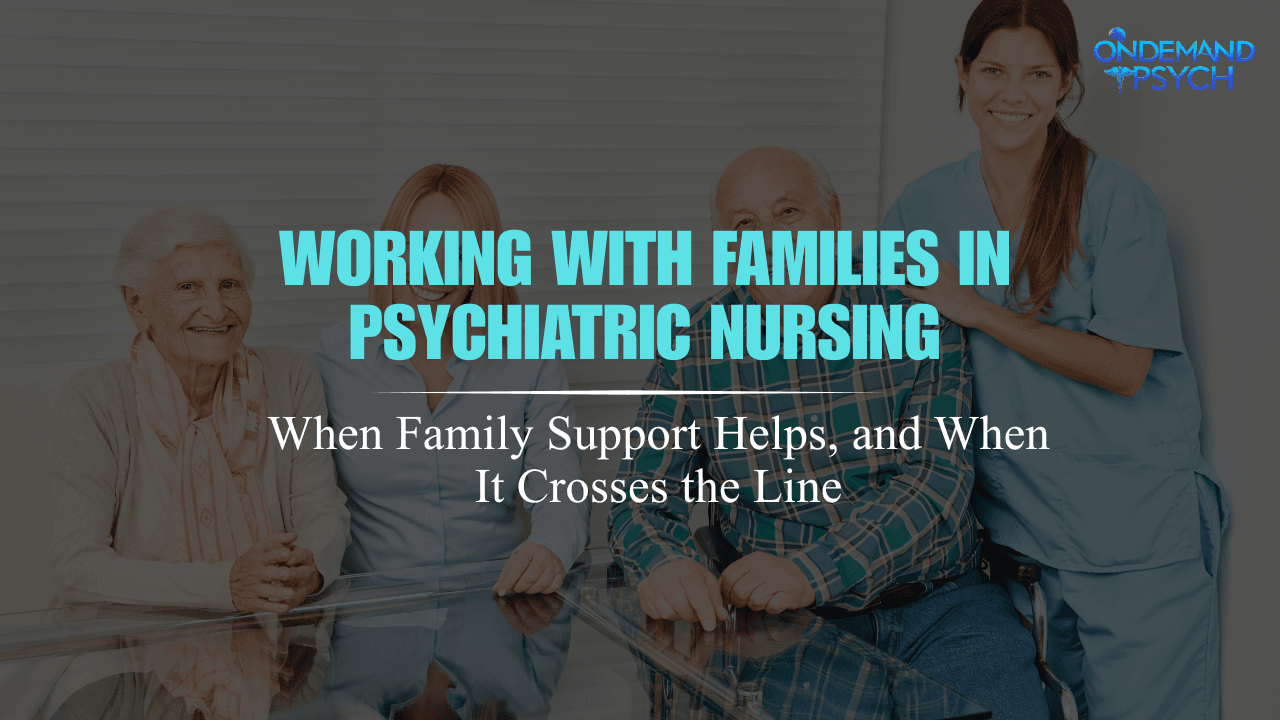
Working With Families in Psychiatric Nursing can be one of the most challenging aspects of mental health care, particularly when family members want information that a patient does not want shared.
A psychiatric nurse is caring for an adult patient experiencing severe depression. The patient's family wants answers. They want to know what medication the patient is taking, whether the patient has discussed suicidal thoughts, what the treatment plan is, and whether they should be worried about what happens after discharge.
The patient, however, says: "I don't want my family involved."
What should the nurse do?
This is where one of the most difficult debates in mental health care begins.
Supporters of family-centered care argue that working with families in psychiatric nursing is essential because recovery rarely occurs in isolation. Families often notice behavioral changes first, help manage appointments and medications, provide housing and emotional support, and become the people responding when symptoms worsen.
Critics raise an equally important concern.
What happens when family involvement compromises privacy, autonomy, or trust?
What happens when the family itself is part of the patient's stress?
And what happens when a psychiatric nurse is pressured to involve relatives without enough time to understand the patient's relationships, safety concerns, or wishes?
The controversy surrounding working with families in psychiatric nursing is therefore not simply about whether families should be included.
It is about how, when, and under what boundaries they should be included.
The answer is not to exclude families from psychiatric care.
Nor is it to assume that family involvement is automatically therapeutic.
The challenge is learning how to transform family involvement from an uncontrolled source of pressure into a structured source of support.

Why Working With Families in Psychiatric Nursing Cannot Be Ignored
The reality is that many families are already involved, whether the healthcare system formally recognizes them or not.
A family member may be the person noticing that sleep has disappeared for several nights. A partner may recognize early warning signs of mania. A parent may be managing transportation to appointments. A sibling may be responding to repeated crisis calls.
Yet family members can also feel excluded from treatment decisions despite carrying significant responsibilities outside the clinical setting.
Recent data from the National Alliance on Mental Illness and the National Alliance for Caregiving highlight the emotional burden carried by family caregivers. In a 2026 analysis drawing on national caregiving data, 64% of caregivers reported moderate to high emotional stress.
This matters because caregiver wellbeing is not separate from patient wellbeing.
A family overwhelmed by fear, confusion, exhaustion, or stigma may struggle to provide stable support. Conversely, a family that receives accurate information and realistic guidance may be better positioned to recognize warning signs and respond appropriately.
This is why working with families in psychiatric nursing is increasingly understood as more than an optional communication strategy.
It is a clinical issue.
But recognizing the importance of families does not resolve the central conflict.
Because the people closest to a patient are not always the people the patient wants involved.
The Argument for Family Involvement in Psychiatric Nursing
The strongest argument for family involvement is practical.
Psychiatric symptoms do not disappear when the appointment ends.
A patient may leave an inpatient unit, outpatient clinic, or emergency department and return to an environment where family members become the primary source of day-to-day support.
Families may observe changes in:
Sleep
Appetite
Medication adherence
Social withdrawal
Agitation
Substance use
Functional decline
Early signs of relapse
Clinical guidelines recognize this reality.
The National Institute for Health and Care Excellence (NICE) recommends that carers of people with psychosis or schizophrenia receive accessible written and verbal information about diagnosis, management, recovery, available support, and what to do in a crisis. NICE also recommends negotiating how information will be shared while respecting both confidentiality and the interdependence between patients and carers.
For psychosis and schizophrenia specifically, NICE states that family members should be offered family intervention and notes that such interventions can improve coping and relapse outcomes.
The evidence therefore supports an important principle:
Families should not be treated as passive observers when they are actively involved in a person's life and recovery.
But the opposing argument becomes equally compelling when family involvement is treated as automatic.

When Working With Families in Psychiatric Nursing Can Become Harmful
The phrase "family-centered care" can sound universally positive.
Real life is more complicated.
Some patients have supportive families.
Others have experienced conflict, criticism, coercion, abuse, rejection, or long-standing emotional instability within their family systems.
For these patients, involving family members without careful assessment may increase distress rather than support recovery.
There is also the issue of confidentiality.
Adult patients generally have the right to control how their personal health information is shared, subject to applicable laws and specific safety circumstances. A well-intentioned family member may believe that being a caregiver gives them automatic access to every clinical detail.
It does not.
This creates one of the most challenging situations in working with families in psychiatric nursing.
The nurse may recognize that the family needs education and support while also understanding that the patient has not consented to sharing personal information.
The solution is not to choose one side and ignore the other.
NICE specifically recommends negotiating early with service users and carers about how information will be shared and regularly reviewing those arrangements when communication difficulties arise.
That approach changes the question.
Instead of asking:
"Should we tell the family everything?"
The nurse can ask:"What information can be shared, what support does the family need, and how can we protect the patient's rights while improving the family's ability to respond safely?"
That distinction is where effective psychiatric nursing begins
The Case Study: When Family Involvement Creates Conflict
Consider a hypothetical inpatient psychiatric patient, Maya.
Maya is a 26-year-old woman admitted following a severe depressive episode with suicidal thoughts. During her admission, she reports a difficult relationship with her parents and specifically requests that staff not discuss the details of her treatment with them.
Her parents repeatedly contact the unit.
They argue that they are her family, that she will be returning home after discharge, and that they have a right to know what is happening.
A nurse faces pressure from both sides.
The patient's parents feel excluded.
The patient feels that her boundaries may not be respected.
The wrong response would be to simply tell the family everything.
But the opposite response, refusing to engage with them entirely, may also leave them frightened and unprepared.
A more clinically balanced approach begins by clarifying Maya's wishes and obtaining consent for any information she is comfortable sharing.
The nurse can then engage the family within those boundaries.
Even when detailed personal information cannot be disclosed, family members may still receive general education about depression, crisis warning signs, available caregiver resources, and how to respond supportively.
This is the critical lesson:
Confidentiality does not necessarily mean abandoning the family.
It means separating the patient's private information from the family's legitimate need for education and support.
How Working With Families in Psychiatric Nursing Can Improve Communication
Communication is often where family involvement succeeds or fails.
Families may arrive with years of unanswered questions.
They may misunderstand psychiatric terminology.
They may interpret symptoms as intentional behavior.
They may blame themselves.
Or they may blame the patient.
The psychiatric nurse has an important role in reducing this confusion.
Effective communication begins with plain language.
Instead of overwhelming families with diagnostic terminology, nurses can explain what symptoms may look like in everyday life and what practical changes deserve attention.
For example, rather than simply saying that a patient is experiencing "decompensation," a nurse might explain that the family should watch for meaningful changes in sleep, functioning, behavior, medication adherence, or the intensity of symptoms.
Listening is equally important.
Families often need an opportunity to describe what they have observed.
Their observations should not automatically override the patient's account, but they can provide clinically relevant context.
The goal is not to decide that either the patient or family is "telling the truth."
The goal is to gather information, identify patterns, and understand the clinical picture without allowing family dynamics to replace professional assessment.

Family Psychoeducation: Information Is a Clinical Intervention
One of the most useful components of working with families in psychiatric nursing is psychoeducation.
Families cannot support what they do not understand.
NICE recommends providing carers with accessible information about diagnosis, treatment, recovery, available services, and what to do during a crisis.
Education can address questions such as:
What symptoms should we monitor?
What changes may suggest relapse?
What medication concerns should be reported?
When should we seek urgent help?
How can we communicate without escalating conflict?
What support is available for caregivers?
This does not mean turning family members into clinicians.
It means helping them become more informed participants in the patient's support system.
For psychosis and schizophrenia, NICE describes family intervention as a structured approach that can last from three months to one year and includes supportive, educational, problem-solving, and crisis-management components.
The broader lesson applies beyond one diagnosis.
Education reduces the gap between being emotionally involved and being practically prepared.
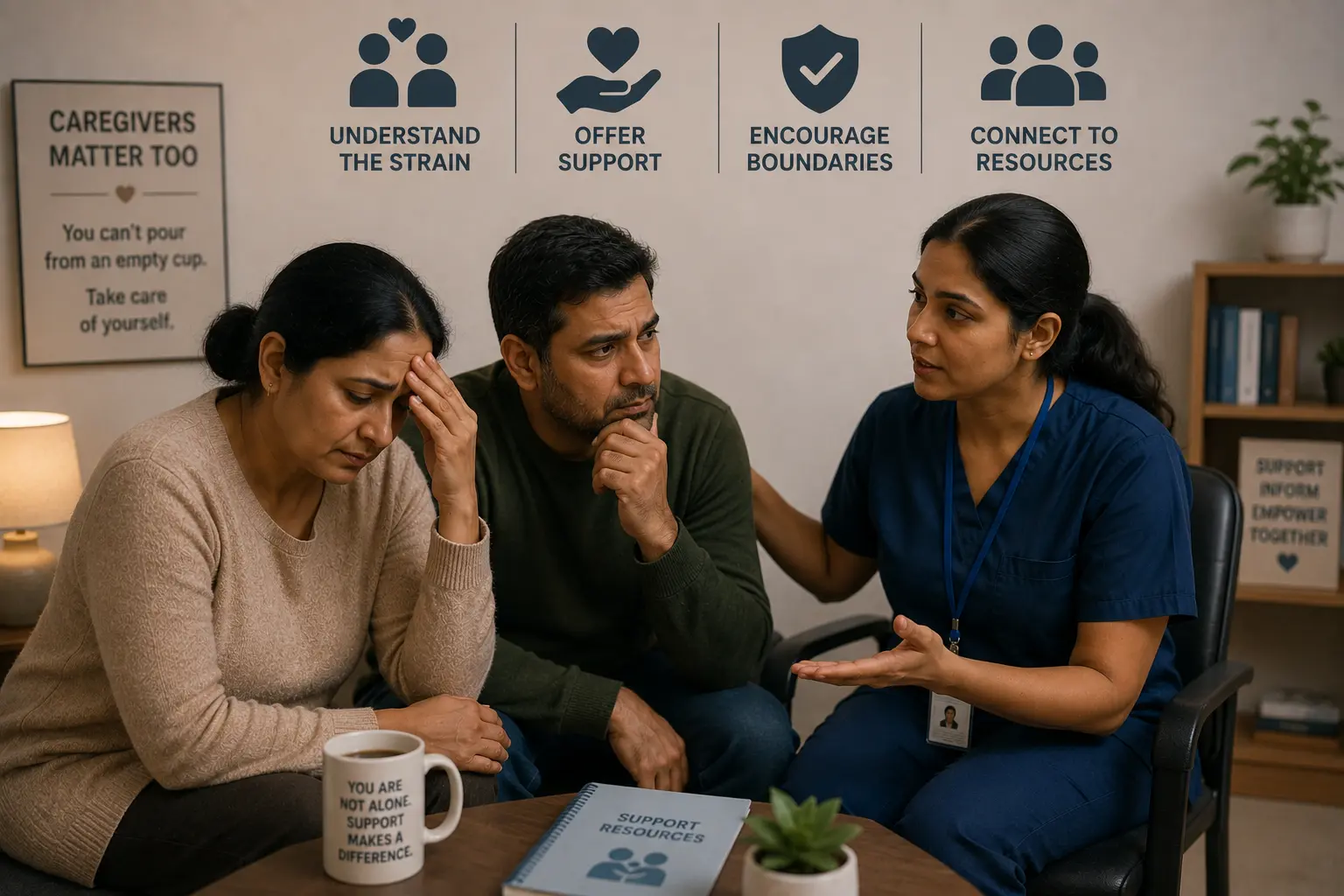
Working With Families in Psychiatric Nursing Requires Recognizing Caregiver Burnout
There is another problem that psychiatric services sometimes overlook.
Families may be expected to provide extraordinary levels of support without receiving meaningful support themselves.
The caregiver may be managing appointments, medication concerns, financial stress, crisis calls, and disrupted sleep while also attempting to maintain employment and relationships.
NAMI and the National Alliance for Caregiving have emphasized that caregiver mental health is not a secondary concern. The emotional strain experienced by caregivers can reflect the pressures placed on families by broader gaps in the healthcare system.
For psychiatric nurses, this creates an important shift in perspective.
Supporting the family is not necessarily a distraction from patient care.
In many circumstances, it is part of patient care.
Nurses can help families recognize caregiver strain and encourage appropriate support, boundaries, and access to community resources.
Sometimes the most valuable intervention is not giving another piece of clinical information.
It is acknowledging:
"You are carrying a lot, and you also need support."
That validation can change how families experience the healthcare system.
Where Clinical Decision Support Can Help Psychiatric Nurses
Family involvement also creates a significant clinical workflow challenge.
The nurse may need to consider the patient's symptoms, treatment plan, safety concerns, medication issues, family observations, confidentiality boundaries, and discharge needs at the same time.
Under pressure, important details can be difficult to organize.
This is where clinical decision-support tools can become relevant, not as replacements for professional judgment, but as systems that help structure it.
On-Demand Psychiatry, described as a Clinical Intelligence Layer for Real-Time Decision Support, fits naturally into this type of clinical challenge.
In family-centered psychiatric care, the problem is often not simply a lack of information.
It is the need to organize multiple sources of information into a coherent clinical picture.
A structured clinical intelligence layer can support real-time reasoning by helping clinicians think through relevant diagnostic, treatment, safety, and workflow considerations while documenting complex encounters.
For example, when a family reports a significant behavioral change that differs from the patient's account, the clinician may need to consider whether the discrepancy reflects a new symptom, a medication issue, a safety concern, or a family communication problem.
Decision-support tools should not decide that question for the clinician.
But they can help ensure that important clinical considerations are not overlooked under time pressure.
That is where technology becomes a logical extension of better family-centered care rather than a replacement for human judgment.
The Practical Framework for Working With Families in Psychiatric Nursing
A useful approach is to organize family involvement around five questions.
1. Who Does the Patient Consider Family?
Do not assume that family means biological relatives.
For some patients, the most important support person may be a partner, close friend, neighbor, or another trusted individual.
The patient's definition should matter.
2. What Does the Patient Consent to Share?
Clarify boundaries early.
Consent may also change over time, which means family communication arrangements may need to be revisited.
3. What Information Does the Family Need?
Even when confidential details cannot be shared, families may still benefit from general education about the condition, crisis response, and caregiver resources.
4. Are Family Dynamics Supporting or Undermining Recovery?
Family involvement should never be assumed to be beneficial without context.
The nurse should remain attentive to conflict, fear, coercion, and other dynamics that may affect the patient's wellbeing.
5. What Should Be Documented?
Clear documentation helps the healthcare team understand:
Who is involved
What the patient has consented to share
What education has been provided
What concerns the family has raised
How those concerns were clinically addressed
This framework helps turn a complicated ethical debate into a practical clinical process.
Resolving the Debate: Family Involvement and Patient Autonomy Are Not Opposites
The controversy surrounding working with families in psychiatric nursing becomes less complicated when we stop treating it as a choice between two extremes.
The first extreme is excluding families entirely.
The second is treating families as automatically entitled to participate in every aspect of care.
Neither approach is consistently patient-centered.
The better approach is structured collaboration.
Patients should retain their voice.
Confidentiality should be respected.
Families should receive support and education.
Clinicians should recognize that family relationships vary dramatically.
And care teams should regularly revisit communication boundaries as clinical circumstances change.
The goal is not maximum family involvement.
The goal is appropriate family involvement.
That distinction resolves much of the tension.
Frequently Asked Questions About Working With Families in Psychiatric Nursing
Why is working with families in psychiatric nursing important?
Families and caregivers may provide emotional support, practical assistance, and important observations about changes in symptoms or functioning. When involvement is appropriate and aligned with the patient's wishes and circumstances, family education and collaboration can support continuity of care.
How can psychiatric nurses involve families while protecting confidentiality?
Nurses should follow applicable privacy laws and organizational policies, clarify what the patient consents to share, and communicate those boundaries clearly. Families may still receive general education and caregiver support even when specific confidential information cannot be disclosed.
What should nurses do when a patient does not want family involved?
The patient's wishes should be taken seriously within applicable legal and safety requirements. Nurses can explore the reasons for the patient's decision, encourage involvement when appropriate, and determine whether general support or education can still be provided to family members without disclosing private information.
How can psychiatric nurses support overwhelmed family caregivers?
Nurses can validate caregiver stress, provide psychoeducation, discuss crisis resources, encourage appropriate boundaries, and connect families with relevant support services or groups.
Can technology support family-centered psychiatric nursing?
Yes. Clinical decision-support systems can help clinicians organize complex information involving symptoms, treatment, safety concerns, family observations, and documentation. These tools should support clinical reasoning rather than replace professional judgment.
Conclusion: Building Healing Connections Without Crossing Boundaries
The most important lesson about working with families in psychiatric nursing is that families should neither be ignored nor automatically given control.
Psychiatric recovery is deeply relational.
The people surrounding a patient may become a source of stability, practical support, early warning, and hope.
They may also carry fear, exhaustion, misunderstanding, and their own unmet needs.
That is why family involvement requires more than good intentions.
It requires communication.
It requires consent.
It requires education.
It requires boundaries.
And increasingly, it requires clinical systems that help healthcare professionals organize complex information and make thoughtful decisions under pressure.
Psychiatric nurses stand at the intersection of these relationships.
They are often the professionals translating clinical information into language families can understand, listening to concerns that might otherwise go unheard, and protecting the patient's right to remain at the center of their own care.
The goal is not to bring every family into every decision.
The goal is to build the right bridge between the patient, the people who support them, and the clinical team.
When that bridge is built carefully, family involvement stops being a threat to autonomy and becomes what it should be:
A structured, informed, and compassionate extension of psychiatric care.

References
- National Institute for Health and Care Excellence. Psychosis and schizophrenia in adults: prevention and management. Link
- National Institute for Health and Care Excellence. Quality statement 3: Family intervention. Link
- National Institute for Health and Care Excellence. Families and carers: Information for the public. Link
- National Alliance on Mental Illness and National Alliance for Caregiving. Caring for the Caregiver: What the Data Tells Us About Mental Health and Family Caregiving. 2026. Link
- National Alliance on Mental Illness. New Report Finds Families Struggle Over a Decade to Get Help for Mental Illness. Link
- Alqarawi N, et al. Factors affecting family-centered care practice by nurses: A systematic review. Journal of Pediatric Nursing. 2024. Link
- On-Demand Psychiatry. Clinical Intelligence Layer for Real-Time Decision Support. Link
Medical disclaimer
This article is intended for licensed healthcare professionals. It does not provide medical advice, diagnose conditions, or substitute for clinical judgment. All clinical decisions must be made by a qualified clinician familiar with the individual patient. For emergencies, call 911. For mental health crisis support in the US, call or text 988.