A five-minute psychiatric note sounds efficient. But learning how to write clear and concise psychiatric notes does not mean sacrificing clinical reasoning or patient care.
It also sounds, to many clinicians, dangerously unrealistic. Psychiatry is not a specialty built around simple transactions.
A follow-up appointment may involve medication decisions, evolving symptoms, risk assessment, diagnostic uncertainty, psychosocial stressors, side effects, psychotherapy, and changes that may be subtle but clinically significant. So when clinicians are told they should learn how to write clear and concise psychiatric notes in under five minutes, an uncomfortable question naturally follows:
Are we improving efficiency, or are we compressing clinical thinking into a dangerously superficial record?
The debate matters because documentation has become one of the most persistent burdens in modern clinical practice. At the same time, psychiatry depends heavily on nuance. A note that fails to communicate risk, clinical reasoning, or treatment decisions can create problems for continuity of care, patient safety, billing, and accountability.
So, can clinicians really learn how to write clear and concise psychiatric notes in under five minutes without compromising quality?
The answer is yes, but with an important qualification.
A concise psychiatric note is not necessarily a rushed psychiatric note. And a long psychiatric note is not necessarily a thorough one.
The real issue is not speed alone. It is whether the documentation accurately captures the clinical work that actually matters.
How to Write Clear and Concise Psychiatric Notes Without Confusing Brevity With Quality
The assumption that more documentation automatically means better documentation is difficult to defend.
The Centers for Medicare & Medicaid Services makes an important distinction in its guidance for evaluation and management services: the volume of documentation should not be the primary influence on the level of service billed. Instead, the medical record should support the service provided and document clinically relevant information, including the reason for the encounter, assessment, relevant risk factors, patient progress, treatment response, and the plan of care.
The American Medical Association makes a similar point in its evaluation and management guidance. The purpose of documentation is ultimately to support patient care and communication between current and future members of the healthcare team, rather than to generate unnecessary volume.
This distinction is crucial for clinicians learning how to write clear and concise psychiatric notes.
A useful note is not a transcript of everything the patient said. It is not a diary of the session. It is not a collection of automatically imported information that no one meaningfully reviewed.
A useful psychiatric note should allow another qualified clinician to understand several essential questions:
Why did the patient present?
What has changed since the previous encounter?
What clinically relevant findings were identified?
What is the clinician's assessment?
Why was a particular treatment decision made?
What happens next?
If those questions can be answered clearly in a concise record, adding hundreds of additional words may not improve the quality of care.
However, brevity has limits. And that is where the controversy begins.
The Documentation Crisis Behind the Demand for Faster Psychiatric Notes
Clinicians are not asking for faster documentation because they suddenly care less about their records.
They are asking because documentation consumes a substantial amount of professional time.
According to data summarized by the American Medical Association from organizations participating in its 2024 Organizational Biopsy, physicians worked an average of 57.8 hours per week. Of that time, approximately 27.2 hours were spent on direct patient care, while an average of 13 hours were spent on indirect patient care activities such as documentation, order entry, test-result interpretation, and referrals. Physicians also reported spending an average of 7.3 hours on administrative tasks such as prior authorization and insurance forms.
That imbalance helps explain why clinicians increasingly search for better ways to manage documentation.
The problem is also not limited to typing speed. The AMA has identified excessive tasks, workflow interruptions, inbox volume, and poor interoperability as important contributors to EHR-related burden. Research and professional discussion surrounding clinician burnout have increasingly focused on the fact that the electronic health record can either support efficient clinical work or add substantial friction to it.
This creates an obvious argument in favor of efficiency.
If clinicians are spending significant portions of their professional and personal time documenting care that has already been delivered, improving documentation workflow is not merely a productivity issue. It may be a professional sustainability issue.
But critics of the "five-minute note" have a valid objection.
Psychiatry is not always predictable enough to be reduced to a five-minute documentation formula.
How to Write Clear and Concise Psychiatric Notes: The Case for Speed
The strongest argument for faster psychiatric documentation is not that clinicians should write less.
It is that clinicians should eliminate unnecessary writing.
A structured follow-up for a stable patient does not necessarily require a lengthy narrative. If the patient reports improved symptoms, demonstrates no new safety concerns, is tolerating medication, and has a straightforward treatment plan, repeating extensive historical information may add length without adding clinical value.
The American Medical Association has explicitly addressed the problem of "note bloat." In discussing modern evaluation and management reforms, the AMA noted that electronic documentation systems and historical documentation requirements contributed to increasingly lengthy records. The organization has supported efforts to make documentation more clinically relevant rather than simply more voluminous.
The AMA also notes that physicians may use note templates to support documentation. However, templates should be reviewed and revised as necessary for the individual patient. The organization specifically recommends reviewing and maintaining templates to reduce note bloat and unnecessary documentation.
That creates an important opportunity for clinicians learning how to write clear and concise psychiatric notes.
Templates can help organize recurring information.
Smart phrases can reduce repetitive typing.
Structured formats such as SOAP can ensure that clinicians consistently address relevant domains.
The American Psychiatric Association has also emphasized the importance of electronic health record functionality that supports psychiatric documentation, including customizable documentation structures and the ability to record clinically relevant psychiatric findings efficiently.
Efficiency can also improve continuity.
A concise note with clearly organized sections may be easier for another clinician to review than a lengthy note containing multiple copied-forward paragraphs. In this sense, clarity itself becomes a patient-care intervention.
The argument is straightforward:
If documentation is repetitive, unfocused, or filled with information that does not influence care, removing that material can make the record better, not worse.
But that argument becomes dangerous when efficiency turns into minimalism.
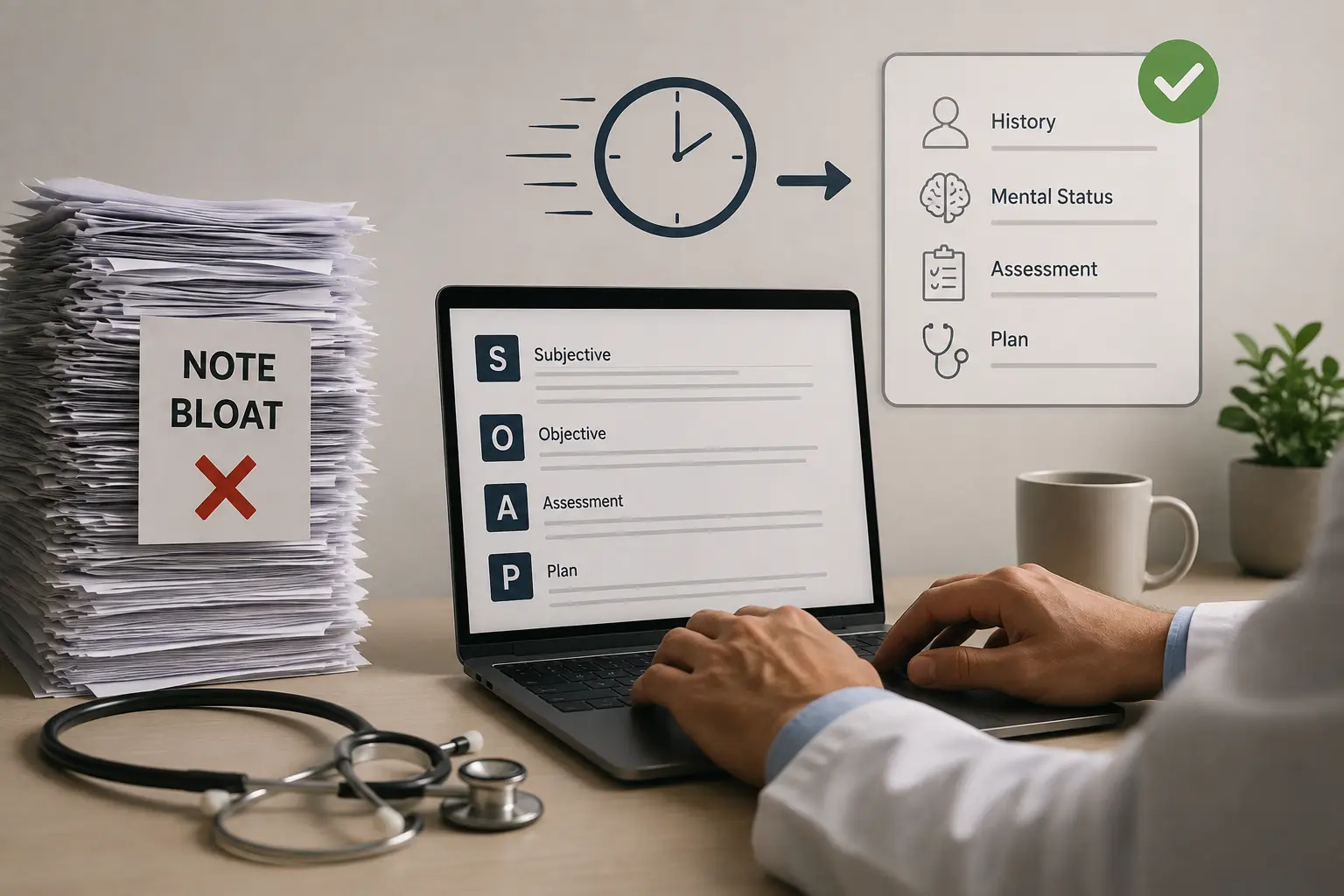
How to Write Clear and Concise Psychiatric Notes Without Becoming Superficial
Here is the problem with aggressively promoting "five-minute notes":
Not every psychiatric encounter is a five-minute documentation encounter.
A stable medication follow-up and a high-risk diagnostic evaluation are not equivalent.
A patient reporting improved anxiety and no safety concerns should not automatically generate the same documentation depth as a patient with new suicidal ideation, diagnostic uncertainty, medication complications, psychosis, or significant functional deterioration.
CMS guidance reflects this principle indirectly by emphasizing that documentation should be appropriate to the service provided and should include clinically relevant information. For outpatient psychiatric services, documentation requirements may include diagnosis, symptoms, functional status, focused mental status findings, treatment planning, prognosis, and progress, depending on the service and setting.
The danger is not concise documentation.
The danger is superficial documentation disguised as efficiency.
This is closely connected to a broader concern in psychiatric practice: whether increasingly streamlined systems are sometimes encouraging clinicians to move through assessment and reasoning too quickly.
That issue is explored in our article, The Psychiatric Evaluation Crisis: Are Modern Mental Health Assessments Becoming Superficial?.
The distinction matters.
A superficial evaluation means the clinician did not adequately explore the clinical problem.
A concise note may simply mean the clinician explored the problem appropriately and documented the clinically relevant findings efficiently.
Those are not the same thing.
Clinical thinking should be thorough when the patient requires thorough thinking. Documentation should then accurately reflect that reasoning without unnecessary repetition.
Case Study: A Five-Minute Psychiatric Note That Works and One That Does Not
Consider a hypothetical outpatient follow-up.
A patient with major depressive disorder returns four weeks after an increase in sertraline. The patient reports improved mood and motivation, is sleeping six to seven hours per night, has mild appetite reduction, denies suicidal or homicidal ideation, and reports no psychotic symptoms. Medication adherence is good, and no significant adverse effects are reported.
The overly brief note
"Patient doing better. Mood improved. No SI. Continue medication."
This note is certainly fast.
It is also limited.
What changed? Which medication is being continued? At what dose? Were side effects assessed? Was there evidence supporting the assessment that the patient is improving? What is the follow-up plan?
The note communicates very little about the clinician's reasoning.
The concise but clinically meaningful note
Subjective
Reports improved mood and motivation since sertraline increase.
Sleeping 6 to 7 hours nightly.
Mild appetite reduction.
Reports adherence to medication.
Denies SI, HI, or psychotic symptoms.
Objective
Alert and cooperative.
Speech normal in rate and volume.
Mood improved; affect appropriate to discussion.
Thought process linear.
No evidence of psychosis during interview.
Assessment
Major depressive disorder, improving following recent medication adjustment.
Mild appetite reduction noted; no significant adverse effects reported.
No acute safety concerns identified during today's assessment.
Plan
Continue sertraline 100 mg daily.
Monitor appetite and tolerability.
Continue psychotherapy recommendations.
Follow up in four weeks or sooner if symptoms worsen.
This version is still concise.
But now the record communicates clinical change, relevant findings, assessment, safety considerations, medication reasoning, and the treatment plan.
That is the difference between short documentation and insufficient documentation.
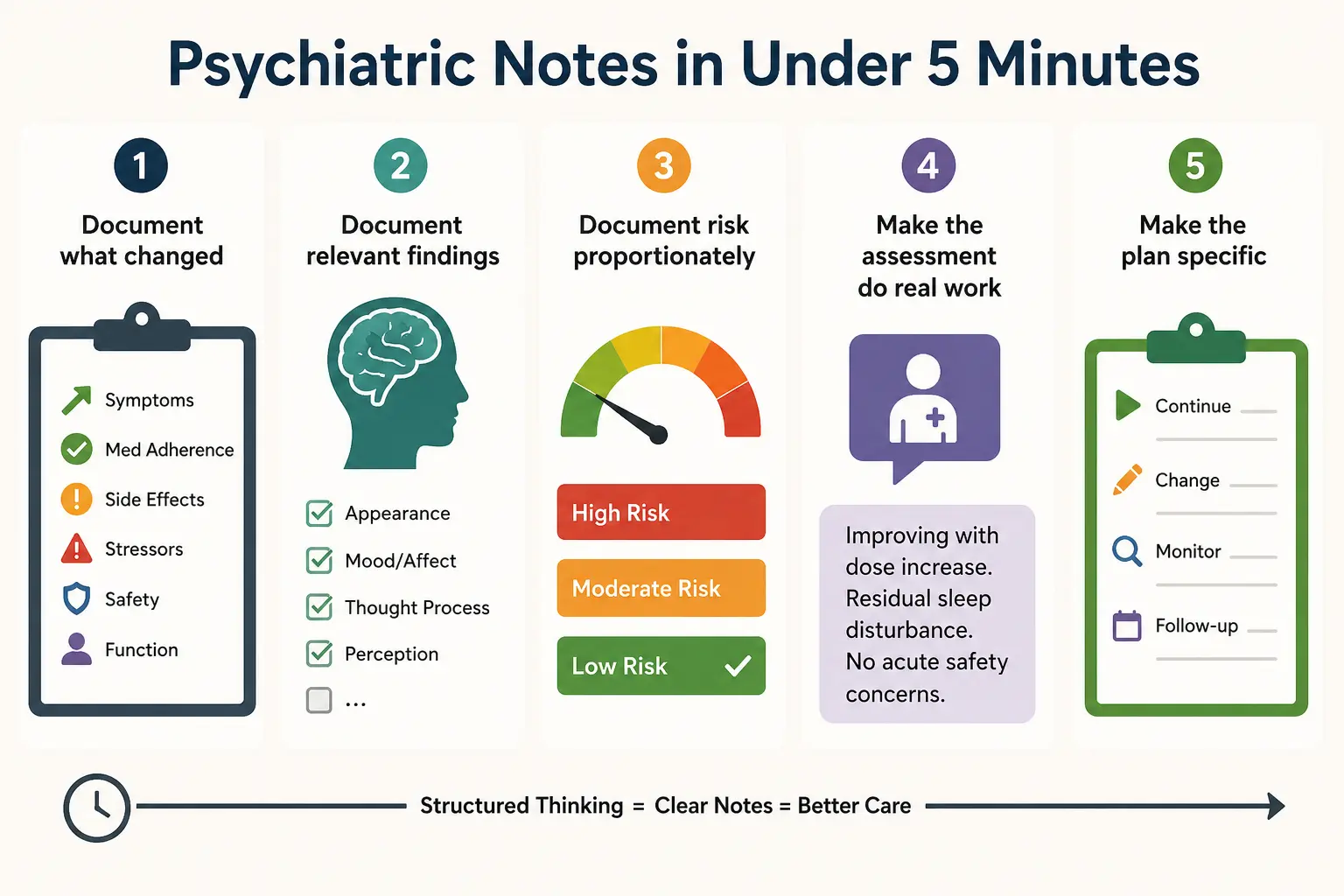
How to Write Clear and Concise Psychiatric Notes in Under 5 Minutes
The fastest way to write better psychiatric notes is not to type faster.
It is to think structurally.
1. Document what changed
For follow-up visits, begin with the most important interval developments.
Did symptoms improve, worsen, or remain stable?
Did medication adherence change?
Were there new side effects, stressors, safety concerns, or functional changes?
CMS documentation principles specifically emphasize the importance of recording patient progress, response to changes in treatment, and updated diagnoses when appropriate.
This immediately prevents the note from becoming a repeated copy of the previous encounter.
2. Document relevant findings, not every possible finding
A complete psychiatric evaluation may require extensive assessment.
A straightforward follow-up may not require every section to be rewritten in identical detail.
Document the mental status findings that are clinically relevant to the encounter and clearly describe significant abnormalities or changes.
The goal is not to create the longest possible mental status examination. The goal is to create an accurate record that reflects the patient's presentation and supports the clinical assessment.
3. Document risk proportionately
Risk assessment should never become an automatic checkbox disconnected from the patient's presentation.
If significant safety concerns are present, the documentation should reflect the assessment and clinical reasoning appropriately.
If the patient is stable, documentation should still accurately reflect relevant safety findings without manufacturing unnecessary narrative.
The complexity of the documentation should follow the complexity of the clinical situation.
4. Make the assessment do real work
The assessment should not simply repeat the diagnosis.
"Major depressive disorder" is a diagnosis.
"Major depressive disorder, improving after recent dose increase with residual sleep disturbance and no acute safety concerns" is a clinical assessment.
That additional reasoning may require only a few words, but it dramatically improves the usefulness of the note.
5. Make the plan specific
A clear plan should answer:
What is continuing?
What is changing?
What should be monitored?
What follow-up is required?
CMS guidance emphasizes the importance of documenting a medical plan of care and ensuring that the medical record supports the service provided.
When these elements are clear, a concise plan can still communicate meaningful clinical direction.
How to Write Clear and Concise Psychiatric Notes Using Templates Without Creating Note Bloat
Templates are one of the most powerful tools for improving documentation speed.
They are also one of the easiest ways to create meaningless documentation.
The AMA specifically warns that templated text should be reviewed and revised as necessary for each individual patient. Templates may support efficient documentation, but they can also contribute to note bloat when clinicians repeatedly import large amounts of irrelevant or outdated information.
Copy-forward content can preserve outdated symptoms.
Automatically generated text can create contradictions.
A note may appear comprehensive while containing information that was never reassessed during the current encounter.
This is why templates should provide structure, not substitute judgment.
Use smart phrases for recurring frameworks.
Use templates for consistent organization.
But review what the template produces.
Remove irrelevant information.
Update changed findings.
Add the reasoning that makes the current encounter different from the previous one.
The template should reduce typing, not replace thinking.
Resolving the Debate: Fast Documentation Is Not the Same as Rushed Documentation
So, is writing psychiatric notes in under five minutes safe?
Sometimes.
But five minutes should not become a universal performance standard.
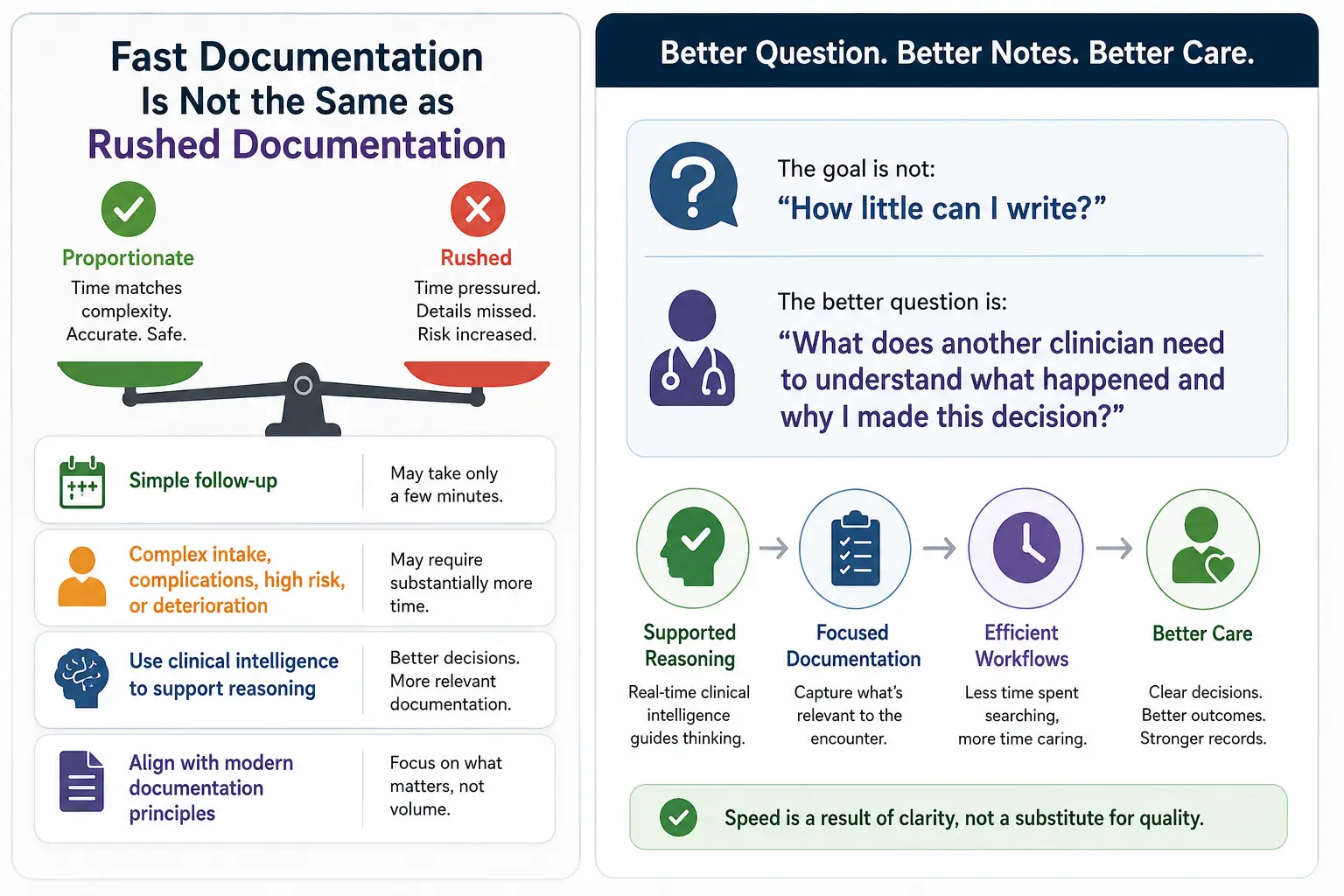
A straightforward follow-up may be documented accurately in only a few minutes. A complex intake, medication complication, high-risk encounter, diagnostic dilemma, or significant clinical deterioration may require substantially more time.
The solution is not to demand that every psychiatric note be short.
The solution is to make every note proportionate to the clinical encounter.
This is where clinical decision-support tools such as On-Demand Psychiatry; Clinical Intelligence Layer for Real-Time Decision Support can become part of the broader solution. When clinicians are managing diagnostic uncertainty, treatment decisions, safety considerations, and documentation under time pressure, the goal should not be to replace clinical judgment or accelerate the encounter artificially. Instead, real-time clinical intelligence can help support structured reasoning and more efficient decision-making, allowing clinicians to focus their documentation on the findings, assessment, and treatment decisions that are most relevant to the patient. In this way, efficiency becomes a result of better-supported clinical reasoning rather than simply asking clinicians to think, assess, and document faster.
This approach is consistent with modern documentation principles. CMS emphasizes that the volume of documentation should not be the primary factor influencing the level of service billed. Instead, the documentation should support the service provided.
The AMA has similarly supported efforts to reduce note bloat and move toward documentation that is clinically relevant rather than unnecessarily extensive.
The goal, therefore, is not:
"How little can I write?"
The better question is:
"What does another clinician need to understand what happened and why I made this decision?"
When that question guides documentation, speed becomes a consequence of clarity rather than a substitute for quality.
Frequently Asked Questions About How to Write Clear and Concise Psychiatric Notes
Can psychiatric notes really be completed in under five minutes?
Yes, some straightforward follow-up notes can be completed in under five minutes when the clinician uses an efficient structure and the encounter is clinically uncomplicated. However, complex evaluations, high-risk encounters, and situations requiring extensive clinical reasoning may appropriately require more time.
How do I write clear and concise psychiatric notes without missing important information?
Focus on clinically relevant changes, significant findings, assessment, risk considerations, treatment reasoning, and the plan. Avoid repeating information that does not influence current clinical decision-making.
Are short psychiatric notes legally acceptable?
Brevity alone does not determine whether documentation is adequate. Requirements vary by jurisdiction, profession, payer, and practice setting. In general, the medical record should accurately support the care provided and meet applicable legal, ethical, organizational, and payer requirements.
CMS specifically states that the volume of documentation should not be the primary influence on the level of service billed. Documentation should support the level of service reported.
What is the best format for fast psychiatric documentation?
SOAP is a useful framework because it separates the patient's report, relevant observations, clinical assessment, and treatment plan. However, the best format is the one that supports accurate documentation and fits the clinician's workflow and organizational requirements.
Do templates and smart phrases improve psychiatric documentation?
They can improve consistency and reduce repetitive typing. However, templates should be reviewed and individualized for each encounter. The AMA specifically recommends maintaining and reviewing templates to reduce note bloat and unnecessary documentation.
Conclusion: The Best Psychiatric Note Is Not the Longest One
The debate over fast psychiatric documentation often starts from the wrong assumption.
It assumes clinicians must choose between two extremes:
Write quickly and risk cutting corners, or write extensively and sacrifice time.
That is a false choice.
Learning how to write clear and concise psychiatric notes is not about documenting less care. It is about removing documentation that does not improve understanding of the care already provided.
A high-quality psychiatric note should reflect the patient, the clinical reasoning, and the treatment plan.
Sometimes that will take five minutes.
Sometimes it will take much longer.
The goal is not to see how little a clinician can write.
The goal is to ensure that every sentence earns its place.
The best psychiatric note is not necessarily the longest note, and it is not necessarily the fastest. It is the note that allows another clinician to understand the patient, follow the clinical reasoning, and continue appropriate care without requiring the original clinician to spend their evening documenting what could have been communicated clearly in minutes.
- Centers for Medicare & Medicaid Services. Link
- Centers for Medicare & Medicaid Services. Evaluation and Management Services, MLN006764. May 2026. Link
- American Medical Association. Link
- American Medical Association. Link
- American Medical Association. Link
- American Medical Association. Link
- American Psychiatric Association. Codes and DoAmerican Medical Association.cumentation for Evaluation and Management Services. Link
- Centers for Medicare & Medicaid Services. Link
- Centers for Medicare & Medicaid Services. Link
- American Medical Association. Link
- National Academies of Sciences, Engineering, and Medicine. Link
This article is intended for licensed healthcare professionals. It does not provide medical advice, diagnose conditions, or substitute for clinical judgment. All clinical decisions must be made by a qualified clinician familiar with the individual patient. For emergencies, call 911. For mental health crisis support in the US, call or text 988.