SSRIs and SNRIs remain among the most widely prescribed medications for depression, anxiety, and several other psychiatric conditions.
Psychiatric medications remain one of the most powerful and misunderstood tools in modern medicine. Clinicians and patients alike are looking for clarity about SSRI drugs, SNRI medications, their mechanisms of action, drug interactions, polypharmacy risks, and evidence-based prescribing.
This comprehensive blog explains:
What SSRIs and SNRIs are
Their mechanism of action
Metabolism and pharmacokinetics
Drug-drug interaction risks
Polypharmacy considerations
Clinical guidelines based on evidence (APA, CANMAT, ASAM)
Practical prescribing insights
Understanding SSRIs
What Is an SSRI?
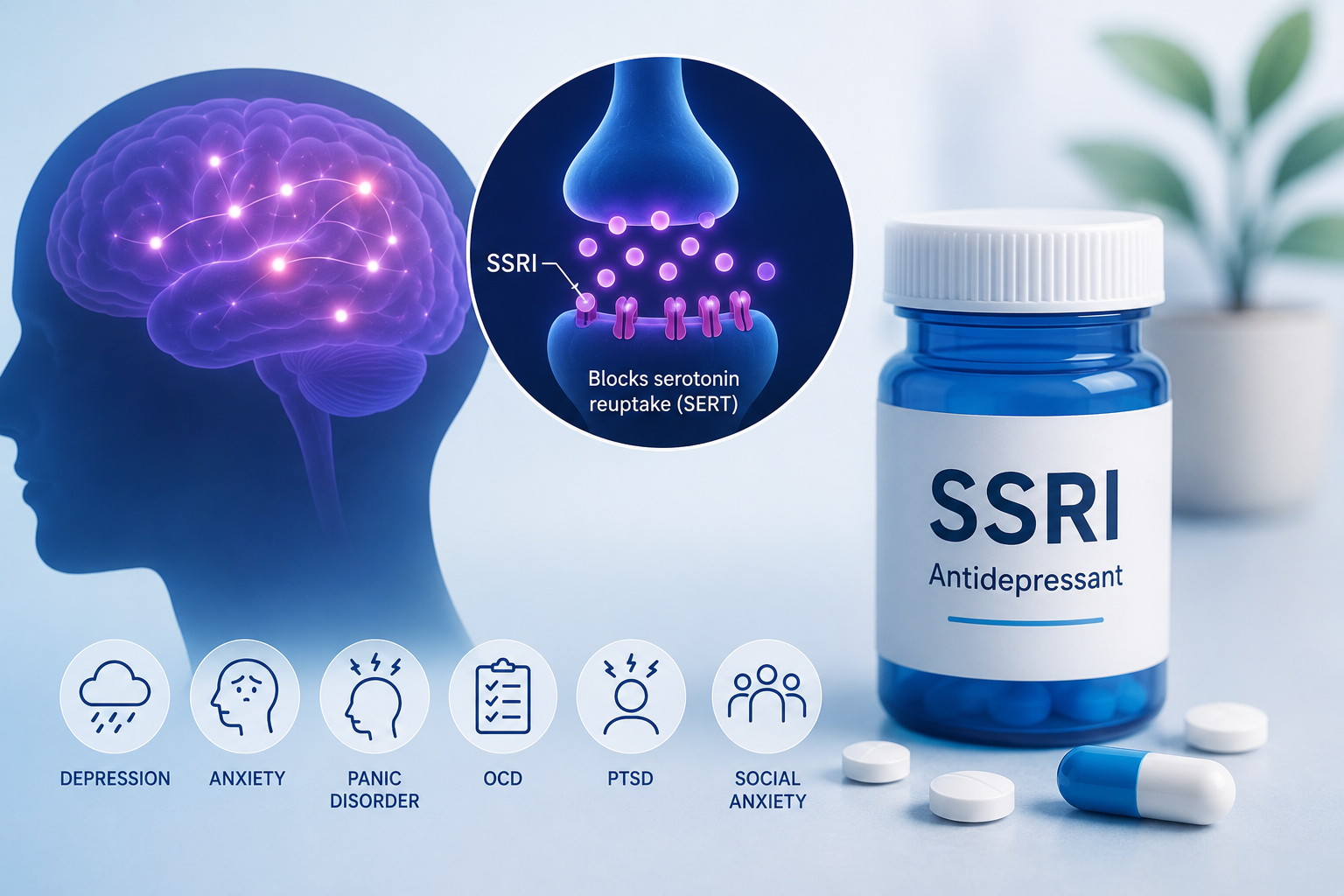
An SSRI (Selective Serotonin Reuptake Inhibitor) is a class of antidepressant that increases serotonin availability in the synaptic cleft by blocking the serotonin transporter (SERT).
Common SSRI examples include:
Sertraline
Fluoxetine
Escitalopram
Paroxetine
Citalopram
Fluvoxamine
These SSRI drugs are widely used for:
Major Depressive Disorder
Generalized Anxiety Disorder
Panic Disorder
OCD
PTSD
Social Anxiety Disorder
How SSRIs Operate: Their Mechanism of Action
By blocking the serotonin transporter, SSRIs prevent serotonin from being reabsorbed at the presynaptic neuron.
Immediate Effect:
Increased serotonin levels in the synaptic space are the immediate result.
Delayed Therapeutic Effect (2-6 weeks):
5-HT1A autoreceptor downregulation is a delayed therapeutic effect that lasts two to six weeks.
Changes in neuroplasticity
A rise in BDNF signaling
Stabilization of functional circuits
This explains why patients frequently inquire as to why SSRIs don't start working right away. The pharmacologic effect happens quickly, but receptor adaptation is necessary for the therapeutic effect.
Understanding SNRIs
What Is an SNRI?
An SNRI (Serotonin Norepinephrine Reuptake Inhibitor) blocks reuptake of both serotonin and norepinephrine.
Common SNRI medications include:
Venlafaxine
Duloxetine
Desvenlafaxine
Levomilnacipran
Milnacipran
SNRIs are particularly useful when depression coexists with:
Neuropathic pain
Fibromyalgia
Chronic fatigue
Severe anxiety with low energy
Mechanism of Action: SSRIs vs SNRIs
SSRIs (Selective Serotonin Reuptake Inhibitors)
Neurotransmitter target: By blocking the serotonin transporter (SERT), the neurotransmitter target primarily raises serotonin (5-HT).
Sedation risk: Overall, the risk of sedation is moderate, although it varies depending on the agent (fluoxetine is more activating, while paroxetine is more sedative).
Effects on blood pressure: Usually has little effect on blood pressure.
Pain benefit: Not usually the first choice for neuropathic or chronic pain syndromes due to its limited analgesic effect.
SNRIs (Serotonin-Norepinephrine Reuptake Inhibitors)
Neurotransmitter target: By blocking SERT and the norepinephrine transporter (NET), you can raise serotonin (5-HT) and norepinephrine (NE).
Risk of sedation: Usually lower than that of many SSRIs; norepinephrine effects may make it more activating.
Effects on blood pressure: Noradrenergic activity may raise blood pressure, especially at higher dosages.
Pain benefit: More proof that treating fibromyalgia, chronic musculoskeletal pain, and neuropathic pain is effective.
Although SNRIs' norepinephrine reuptake inhibition may improve motivation, energy, and focus, it also makes it more important to keep an eye on heart rate and blood pressure, particularly at moderate to high dosages.
Pharmacokinetics and Metabolism
Understanding pharmacokinetics is essential for safe prescribing.
CYP450 Metabolism
Fluoxetine is a CYP2D6 inhibitor
Paroxetine is a strong CYP2D6 inhibitor
Fluvoxamine is a CYP1A2 & CYP2C19 inhibitor
Sertraline has a moderate CYP2D6 interaction
Venlafaxine is metabolized via CYP2D6
Duloxetine is metabolized by CYP1A2 and CYP2D6
Half-lives vary significantly:
Fluoxetine has a long half-life (active metabolite norfluoxetine)
Paroxetine has a short half-life (withdrawal risk)
Venlafaxine discontinuation syndrome is well documented
Drug-Drug Interactions
One of the most searched concerns in psychiatry is drug-drug interaction.
Major Risk Areas:
Serotonin Syndrome
SSRI/SNRI + MAOI
SSRI/SNRI + linezolid
SSRI/SNRI + triptans
SSRI/SNRI + tramadol
QTc Prolongation
Higher concern with citalopram
Risk increases in polypharmacy
CYP450 Inhibition
Can raise levels of antipsychotics, beta blockers, TCAs
Bleeding Risk
SSRIs + NSAIDs
SSRIs + anticoagulants
Polypharmacy significantly increases interaction probability.
Evidence-Based Clinical Guidelines
Psychiatric prescribing should align with established clinical guidelines:
American Psychiatric Association (APA)
Canadian Network for Mood and Anxiety Treatments (CANMAT)
American Society of Addiction Medicine (ASAM)
These guidelines recommend:
SSRIs as first-line treatment for depression and anxiety
SNRIs for patients with comorbid pain or partial SSRI response
Careful monitoring during medication switches
Gradual tapering to prevent discontinuation syndrome
Monitoring Requirements
Baseline:
Suicide risk assessment
Blood pressure (especially SNRIs)
Weight
Drug interaction review
Follow-Up:
Symptom rating scales (PHQ-9, GAD-7)
Blood pressure (for SNRIs)
Side effect review
Activation or agitation monitoring
Special Populations
Pregnancy
SSRIs are generally considered safer than untreated depression; a risk-benefit analysis is required.
Elderly
Hyponatremia risk
Fall risk
QTc monitoring
Adolescents
Black-box warning for suicidality
Clinical Pearls
Not all SSRIs are equal; receptor binding profiles differ.
Paroxetine tends to be more sedating and weight-promoting.
Fluoxetine may be activating and helpful in low-energy depression.
Duloxetine may benefit patients with chronic pain syndromes.
Venlafaxine may increase blood pressure at higher doses.
Choosing the “best SSRI for anxiety” or “best SNRI for depression” depends on patient-specific factors, not marketing claims.
Where Clinical Decision Support Matters
As medication complexity increases, clinicians must evaluate:
Mechanism of action
CYP450 pathways
Cross-taper strategies
Drug-drug interaction risk
Polypharmacy safety
Guideline alignment
This is where structured, psychiatry-specific decision support becomes valuable.
Modern platforms like On-Demand Psychiatry, designed as a psychiatric clinical intelligence layer, help clinicians:
Analyze medication interactions in real time
Cross-check polypharmacy risks
Align prescribing with DSM-5-TR diagnoses
Integrate APA, CANMAT, and ASAM guidance
Generate defensible documentation
The goal is not to replace clinical judgment but to strengthen it.
Concluding remarks
SSRIs and SNRIs continue to be the cornerstones of treatment for anxiety and depression. Although their mode of action is well known, safe prescribing necessitates paying close attention to:
Pharmacokinetics
Drug Interactions
Polypharmacy
Special populations
Evidence-based clinical guidelines
These drugs have the potential to change lives when taken carefully.
Risks rise when prescriptions are given without systematic oversight.
Clinical knowledge and decision support are essential in modern psychiatry to guarantee that each SSRI prescription and SNRI modification is safe, individualized, and supported by evidence.
Frequently Asked Questions (FAQs)
1. What is the difference between SSRIs and SNRIs?
SSRIs (Selective Serotonin Reuptake Inhibitors) increase serotonin levels only.
SNRIs (Serotonin Norepinephrine Reuptake Inhibitors) increase both serotonin and norepinephrine.
SSRIs are typically first-line for depression and anxiety. SNRIs may be preferred when fatigue or chronic pain is present.
2. What are common SSRI drugs?
Common SSRI medications include:
Sertraline
Fluoxetine
Escitalopram
Paroxetine
Citalopram
These are widely prescribed for depression, anxiety disorders, OCD, and PTSD.
3. What are common SNRI medications?
Common SNRI drugs include:
Venlafaxine
Duloxetine
Desvenlafaxine
They are often used when depression includes low energy or pain symptoms.
4. How long do SSRIs take to work?
SSRIs begin altering serotonin levels immediately, but symptom improvement usually takes 2-6 weeks due to neuroadaptive changes in the brain.
5. What are common side effects of SSRIs and SNRIs?
Common side effects include:
Nausea
Sleep changes
Sexual dysfunction
Headache
Mild anxiety activation
SNRIs may also increase blood pressure at higher doses.
6. What is serotonin syndrome?
Serotonin syndrome is a potentially serious reaction caused by excessive serotonin activity, often due to drug-drug interactions. Symptoms may include agitation, tremor, sweating, confusion, and fever. Immediate medical care is required.
7. What is polypharmacy in psychiatry?
Polypharmacy refers to using multiple psychiatric medications simultaneously. While sometimes necessary, it increases risks of drug-drug interactions, QTc prolongation, sedation stacking, and metabolic burden.
8. How are drug-drug interactions checked with SSRIs and SNRIs?
Clinicians evaluate:
CYP450 metabolism
Serotonergic stacking risk
QTc prolongation potential
Blood pressure effects
Careful review is especially important when multiple medications are prescribed.
9. How do clinical guidelines influence SSRI and SNRI prescribing?
Organizations such as the APA, CANMAT, and ASAM recommend SSRIs as first-line treatment for many depressive and anxiety disorders, with SNRIs used when clinically indicated. Guideline alignment improves safety and outcomes.
10. How does On-Demand Psychiatry support SSRI and SNRI prescribing?
On-Demand Psychiatry, designed as a psychiatric clinical intelligence layer, helps clinicians:
Review drug-drug interaction risks
Evaluate polypharmacy safety
Align prescribing with DSM-5-TR diagnoses
Follow evidence-based clinical guidelines
Generate structured documentation
It enhances clinical decision-making while preserving clinician judgment.
This article is intended for licensed healthcare professionals. It does not provide medical advice, diagnose conditions, or substitute for clinical judgment. All clinical decisions must be made by a qualified clinician familiar with the individual patient. For emergencies, call 911. For mental health crisis support in the US, call or text 988.