For years, psychedelics and NP practice were rarely discussed in the same conversation. Psychedelics were treated as either a counterculture curiosity or a dangerous class of Schedule I substances.
Now they are being discussed in FDA advisory meetings, randomized clinical trials, state regulatory programs, academic medical centers, and psychiatric practices.
And that creates a provocative question for Nurse Practitioners:
Are NPs about to become major players in psychedelic medicine, or is the industry moving faster than the evidence, regulation, and professional training can support?
The answer is not as simple as the headlines suggest.
Psychedelics and NP practice are moving closer together, but the path is not a straight line from promising research to prescribing authority. MDMA remains unapproved by the FDA for PTSD. Psilocybin remains federally controlled even where state-regulated access exists. Ketamine is widely used off-label in psychiatry, while FDA-approved esketamine has a specific indication and significant safety requirements. And an NP's ability to prescribe, administer, monitor, or provide psychotherapy-related services depends heavily on state law, credentials, setting, and the particular treatment involved.
So the real opportunity is not simply learning how to administer a psychedelic.
It is understanding where psychedelic medicine belongs within responsible psychiatric care, and where an NP's role begins and ends.

Psychedelics and NP Practice Are Entering a New Era
The scientific case for studying psychedelic therapies has become increasingly difficult to ignore.
In a confirmatory phase 3 trial published in Nature Medicine, MDMA-assisted therapy produced significantly greater reductions in PTSD symptoms and functional impairment than therapy with placebo in adults with moderate to severe PTSD. The study included 104 randomized participants, and the MDMA-assisted therapy group had a larger improvement in CAPS-5 scores than the placebo-plus-therapy group.
Psilocybin research is also advancing.
A 2025 systematic review and meta-analysis of six randomized controlled trials involving 427 participants found that psilocybin-assisted therapy was associated with significantly greater reductions in depression symptoms than control conditions. The analysis also found higher response and remission rates, although the authors emphasized the need for continued research.
These findings do not mean that psychedelics are ready to replace antidepressants or psychotherapy.
They mean something more important:
The question has moved from "Do psychedelics deserve serious scientific attention?" to "How should these treatments be developed, regulated, delivered, and integrated into healthcare?"
That is where Nurse Practitioners enter the conversation.
Psychedelic Medicine Is Not One Thing
One of the biggest problems with the phrase "psychedelic therapy" is that it makes several very different treatments sound interchangeable.
They are not.
Psilocybin is a classic psychedelic that produces profound alterations in perception and consciousness.
MDMA is a psychoactive compound with distinctive empathogenic and stimulant properties and is being studied in combination with psychotherapy, particularly for PTSD.
Ketamine is different again. Pharmacologically, it is a dissociative anesthetic rather than a classic serotonergic psychedelic. Yet it is frequently discussed alongside psychedelic medicine because of its rapid antidepressant effects and its ability to produce altered states of consciousness.
These distinctions matter clinically and legally.
They matter even more for NPs.
A clinician considering ketamine treatment is operating within a very different regulatory environment from one participating in an investigational psilocybin or MDMA trial.

Ketamine Therapy for Nurse Practitioners: The Most Accessible Entry Point
Of all the treatments associated with psychedelic medicine, ketamine is currently the most established pathway for psychiatric practice.
But even here, precision matters.
Ketamine itself is not FDA-approved for depression or another psychiatric disorder. FDA-approved injectable ketamine is indicated as an anesthetic. The FDA has recognized that ketamine has been used off-label for conditions such as treatment-resistant depression, but off-label use is not the same thing as FDA approval.
Esketamine, marketed as Spravato, is different.
The FDA approved intranasal esketamine for adults with treatment-resistant depression and for depressive symptoms in adults with major depressive disorder with acute suicidal ideation or behavior, in conjunction with an oral antidepressant. It is subject to a restricted REMS program because of risks including sedation, dissociation, respiratory depression, and misuse. Patients must receive it in a certified healthcare setting and be monitored for at least two hours after administration.
That distinction creates an important lesson for NPs:
"Ketamine therapy" is not one regulatory category.
The drug, formulation, indication, route, setting, prescribing authority, and monitoring requirements all matter.
For an NP considering this field, the first question should therefore not be:
"How do I get certified in ketamine therapy?"
It should be:
"What exactly am I legally and clinically authorized to do with this treatment in my state and practice setting?"
Psychedelics and NP Practice Depend on State Scope of Practice
There is no single national answer to what an NP can do with psychedelic medicine.
The American Association of Nurse Practitioners classifies states as full, reduced, or restricted practice environments. In full-practice states, NPs have authority under state law to evaluate patients, diagnose, order and interpret tests, initiate and manage treatment, and prescribe medications and controlled substances. Reduced- and restricted-practice states impose additional limitations or requirements.
That means psychedelic medicine does not create a new exception to scope-of-practice law.
An NP cannot assume that because a treatment is legally available somewhere, the NP automatically has authority to prescribe or administer it.
The relevant questions include:
What does the state nurse practice act permit?
Does the NP have prescriptive authority for the relevant controlled substance?
Are there facility or credentialing requirements?
Does the treatment require physician involvement?
Is the NP acting as a prescriber, medical clinician, therapist, researcher, or psychedelic facilitator?
Is the treatment FDA-approved, off-label, investigational, or part of a state-regulated program?
That distinction protects both the patient and the clinician.
Psilocybin Therapy for Depression: Legal Does Not Always Mean Medical
This is where psychedelic medicine becomes particularly complicated.
Oregon has created a regulated psilocybin services system. Adults aged 21 or older can access psilocybin services without a prescription or medical referral, but they must complete a preparation session and consume psilocybin at a licensed service center in the presence of a licensed facilitator.
That is very different from saying:
"Psilocybin is FDA-approved to treat depression in Oregon."
It is not.
Psilocybin remains a Schedule I substance under federal law, even though Oregon permits regulated psilocybin services under state law.
Oregon's model is also evolving.
Beginning January 1, 2026, Oregon rules allow facilitators who also hold certain professional licenses, including licenses from the Oregon State Board of Nursing, to provide specified health or behavioral health services during preparation and integration sessions, subject to the state's requirements.
That development is particularly relevant to psychedelics and NP practice.
It demonstrates that the future NP role may not necessarily begin with prescribing the psychedelic.
It may begin with what happens before and after the psychedelic experience.
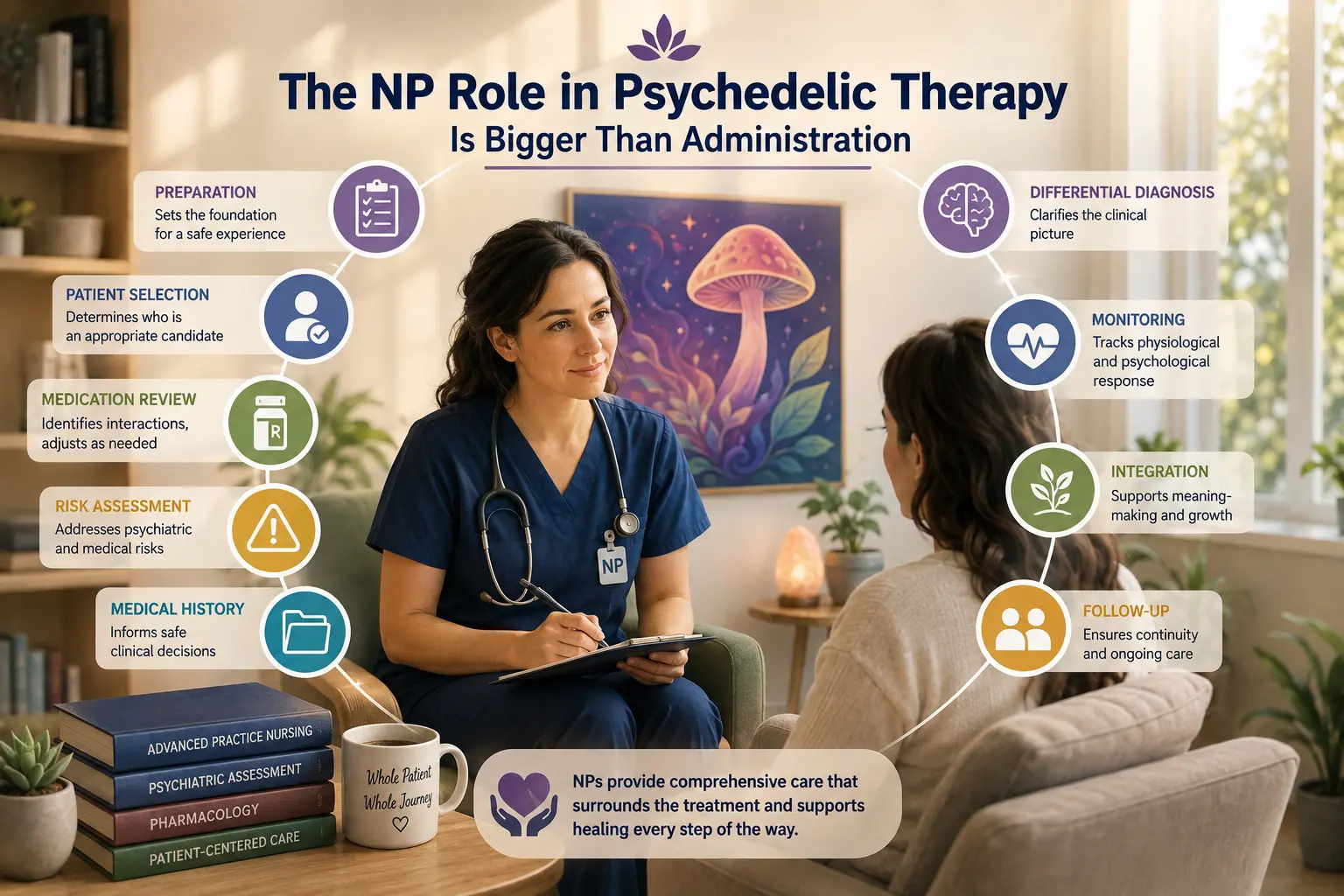
The NP Role in Psychedelic Therapy May Be Bigger Than Administration
The most interesting future role for NPs may not be "the person who gives the drug."
It may be the clinician who surrounds the treatment with good psychiatric care.
Preparation matters.
Patient selection matters.
Medication review matters.
Risk assessment matters.
Medical history matters.
Differential diagnosis matters.
Monitoring matters.
Integration matters.
Follow-up matters.
These are areas where advanced practice nursing already has a strong foundation.
An NP may be involved in evaluating whether a patient is an appropriate candidate, identifying psychiatric or medical factors that require caution, reviewing current medications, establishing expectations, monitoring physiological or psychological responses where permitted, coordinating with therapists, and managing follow-up care.
That is considerably more sophisticated than simply administering a substance.
MDMA Therapy and NPs: The Promise Is Real, but the Legal Status Matters
MDMA-assisted therapy illustrates why enthusiasm needs to be separated from regulatory reality.
The clinical evidence is compelling enough to justify continued development.
In the phase 3 Nature Medicine study, 71.2% of participants in the MDMA-assisted therapy group no longer met PTSD criteria by the end of the study, compared with a lower proportion in the placebo-plus-therapy group. The treatment also produced significantly greater improvements in functional impairment.
But promising evidence is not the same as FDA approval.
The FDA convened an advisory committee in June 2024 to evaluate an application for MDMA capsules for PTSD. The agency's materials described significant evidence of efficacy but also raised questions around benefit-risk, study design, psychotherapy standardization, and safety.
As of 2026, MDMA-assisted therapy is not an FDA-approved treatment for PTSD.
That means an NP cannot simply treat MDMA-assisted therapy like an established psychiatric medication.
For now, opportunities may exist primarily through research, investigational pathways, or future regulated models rather than ordinary prescribing.
The distinction is critical.
Psychedelic Certification for NPs: What Does "Certified" Actually Mean?
Searches for NP psychedelic certification are likely to become increasingly common.
But prospective clinicians should be careful.
There is no single nationally recognized license that automatically authorizes an NP to practice psychedelic-assisted therapy.
A certificate from a private educational organization may demonstrate training.
It does not automatically expand a clinician's legal scope of practice.
This distinction is especially important because psychedelic care combines multiple professional competencies.
An NP may need education in psychedelic pharmacology, psychiatric assessment, trauma-informed care, risk management, altered states of consciousness, preparation and integration, emergency response, ethics, and professional boundaries.
But completing a training program does not override state law.
The AANP emphasizes that NPs must understand the specific practice rules governing their state, including prescriptive authority and other regulatory requirements.
Therefore, the better question is not:
"Which certification makes me a psychedelic practitioner?"
It is:
"Which education, credentials, supervised experience, and legal authorities do I need for the exact role I intend to perform?"
Psychedelics and NP Practice Need More Than Enthusiasm
The psychedelic field has an unusual problem.
It has generated enormous excitement at exactly the same time that evidence, regulation, commercial interest, and public expectations are rapidly evolving.
That creates a dangerous gap between possibility and practice.
A patient may hear that psilocybin can help depression and assume it is a proven replacement for conventional treatment.
A clinician may hear that ketamine can rapidly reduce depressive symptoms and underestimate the importance of screening, monitoring, and substance-use risk.
A training organization may offer a "psychedelic certification" that sounds more authoritative than it actually is.
And a clinic may market an emerging treatment more aggressively than the evidence justifies.
The NP has to be the person who slows the process down.
That means asking:
Who is the right patient?
What is the actual evidence?
What are the contraindications?
What is the treatment target?
What is the role of psychotherapy?
What happens if the patient becomes destabilized?
Who manages the patient afterward?
Those questions are not obstacles to psychedelic medicine.
They are what make psychedelic medicine clinically credible.

Psychedelic-Assisted Therapy Requires a Different Kind of Clinical Judgment
Psychedelic experiences can be psychologically intense.
That means the clinical relationship surrounding the intervention matters enormously.
A patient may experience fear, grief, trauma memories, perceptual changes, emotional flooding, dissociation, or unexpected psychological material.
The clinician must understand that the patient's experience is not automatically therapeutic simply because it is profound.
A difficult experience is not necessarily a breakthrough.
An emotional experience is not necessarily resolution.
A mystical experience is not necessarily recovery.
And symptom improvement immediately after treatment does not automatically establish long-term benefit.
This is where the NP's traditional strengths become relevant.
Psychiatric assessment.
Therapeutic communication.
Risk assessment.
Medication management.
Patient education.
Longitudinal follow-up.
Coordination of care.
These capabilities become even more important when treatment produces an unusually intense psychological experience.
The Safety Debate: Who Is Responsible When Something Goes Wrong?
This may be the most important unanswered question in psychedelic medicine.
Suppose a patient becomes severely anxious during a session.
Who is responsible?
What if a patient develops mania after an intervention?
What if psychotic symptoms emerge?
What if dissociation becomes prolonged?
What if a patient misuses ketamine outside the intended treatment protocol?
What if a patient interprets an intense psychedelic experience as evidence that they should discontinue all psychiatric treatment?
These are not theoretical concerns.
They are precisely the kinds of situations that make psychedelic medicine different from simply prescribing another antidepressant.
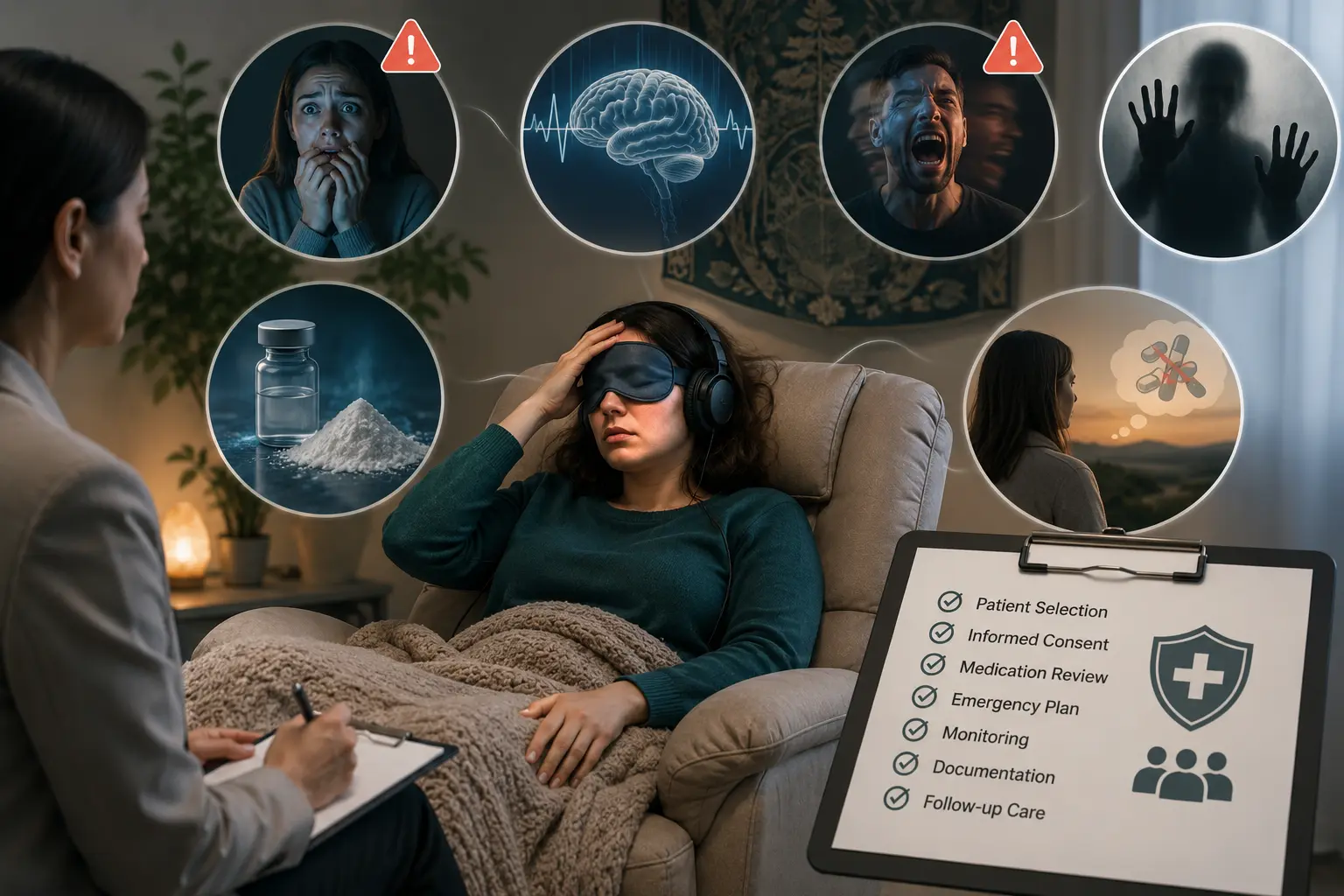
The clinician needs a defined safety pathway before treatment begins.
That includes patient selection, informed consent, medication review, emergency planning, monitoring, documentation, follow-up, and clear responsibility for post-treatment care.
A Clinical Intelligence Layer Could Become Important in Psychedelic Care
This is also where the broader evolution of psychiatric technology becomes relevant.
Psychedelic medicine creates unusually complex clinical workflows.
A clinician may need to integrate psychiatric history, medication exposure, substance-use history, medical conditions, previous treatment response, risk factors, session observations, symptom measurements, and post-session changes.
The challenge is not simply collecting that information.
It is reasoning through it in real time.
This is where a clinical intelligence approach such as On-Demand Psychiatry, Clinical Intelligence Layer for Real-Time Decision Support, can be conceptually useful.
Rather than replacing the clinician or independently deciding whether a patient should receive a psychedelic treatment, a clinical intelligence layer can help organize the information surrounding a complex decision.
For example, it could help a clinician structure:
the patient's diagnostic history
previous medication trials
current medication exposure
relevant safety considerations
differential diagnoses
treatment goals
potential monitoring needs
follow-up considerations
documentation of clinical reasoning
That matters because psychedelic medicine should not be built around the idea that the intervention itself is the treatment.
The treatment is the entire clinical pathway.
A clinical intelligence layer can support that pathway by helping clinicians move from fragmented information toward a more structured decision, particularly when the case is complicated and the clinical stakes are high.
The system does not replace the NP's judgment.
It helps make the reasoning around that judgment more visible and organized.
And in an emerging field where patient selection and safety may be just as important as the intervention itself, that distinction matters.
The Future of Psychedelics and NP Practice
The future is unlikely to look like every NP suddenly becoming a psychedelic prescriber.
It will probably be much more structured.
Some NPs will work in ketamine-based psychiatric services.
Some will participate in clinical research.
Some will become trained in preparation and integration.
Some will work within state-regulated psilocybin programs where their professional licenses and facilitator credentials permit it.
Some will focus on psychiatric assessment and medication management around psychedelic treatments.
Others will contribute to education, policy, research, and clinical governance.
And many will decide that the evidence is not yet strong enough for their particular practice.
All of those positions can be reasonable.
The important issue is whether the clinician's role is based on evidence, competence, law, and patient safety, rather than excitement about a rapidly growing market.
Resolving the Debate: Should NPs Enter Psychedelic Medicine?
Yes.
But not simply because psychedelics are fashionable.
And not because the future supposedly belongs to psychedelic medicine.
NPs should enter this field because they have a legitimate opportunity to contribute to a rapidly developing area of mental healthcare, provided that participation is grounded in evidence, appropriate education, state scope-of-practice law, careful patient selection, and strong clinical governance.
The opportunity is real.
So are the risks.
The most responsible future is therefore not unrestricted psychedelic access.
It is structured psychedelic care.
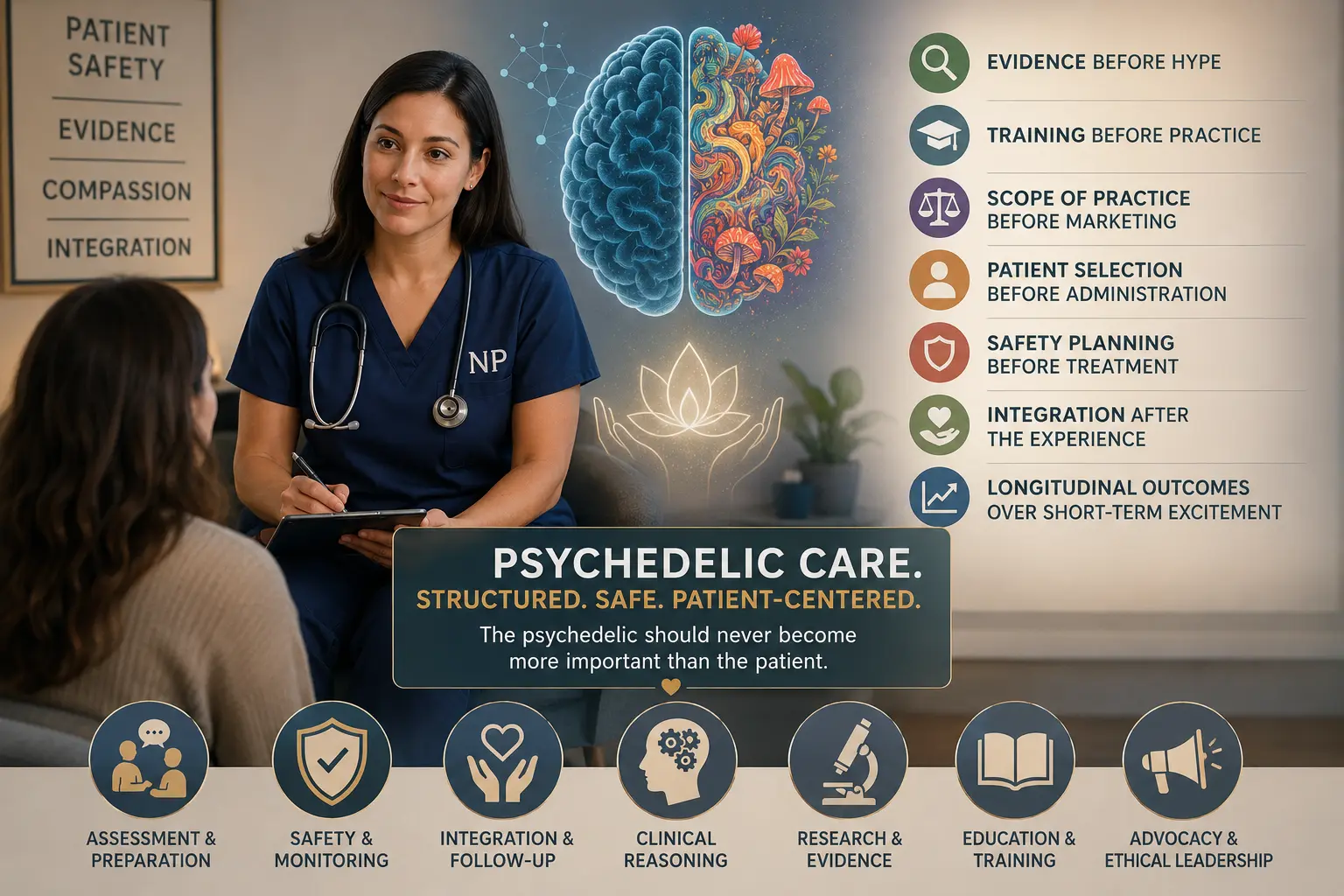
That means:
Evidence before hype.
Training before practice.
Scope of practice before marketing.
Patient selection before administration.
Safety planning before treatment.
Integration after the experience.
Longitudinal outcomes instead of short-term excitement.
And perhaps most importantly:
The psychedelic should never become more important than the patient.
That is where Nurse Practitioners can make a meaningful contribution.
The future of psychedelic medicine will not be determined solely by whether psilocybin, MDMA, or related treatments demonstrate efficacy.
It will also be determined by whether healthcare professionals build systems capable of delivering these interventions responsibly.
That is where the NP role becomes much more interesting.
The question is no longer simply:
"Can NPs prescribe psychedelics?"
The better question is:
"What should an NP's role be in a new model of psychiatric care that includes psychedelic medicine?"
The answer may encompass far more than prescribing.
It may involve assessment.
Preparation.
Safety.
Monitoring.
Integration.
Clinical reasoning.
Research.
Education.
And advocacy.
The psychedelic era, if it arrives at scale, will need clinicians who understand that an altered state is not the same thing as a treatment, a powerful experience is not the same thing as recovery, and promising research is not the same thing as established medicine.
That is precisely why the future of psychedelics and NP practice should be built around clinical competence, not clinical hype.
Frequently Asked Questions About Psychedelics and NP Practice
Can Nurse Practitioners prescribe psychedelics?
It depends on the substance, indication, state law, and practice setting. Ketamine itself is FDA-approved as an anesthetic, not for psychiatric treatment, although it is sometimes used off-label. Esketamine is FDA-approved for specific depressive indications under a restricted REMS program. Psilocybin and MDMA remain federally controlled and are not ordinary FDA-approved psychiatric prescriptions.
Is ketamine a psychedelic?
Ketamine is more accurately classified pharmacologically as a dissociative anesthetic rather than a classic serotonergic psychedelic. It is often discussed alongside psychedelic medicine because of its psychoactive effects and emerging role in psychiatric treatment.
Can NPs provide ketamine therapy?
Potentially, depending on state scope of practice, prescriptive authority, the specific ketamine product and indication, clinical setting, credentialing, and applicable federal and state requirements. NP scope of practice varies substantially across the United States.
Is MDMA therapy legal for NPs?
MDMA-assisted therapy for PTSD is not currently an FDA-approved treatment. MDMA remains federally controlled, so NPs should not assume that promising clinical-trial results create ordinary prescribing authority. Access to investigational drugs generally occurs through clinical trials or applicable FDA pathways.
Is psilocybin therapy legal?
Psilocybin remains federally controlled in the United States. However, Oregon has established a state-regulated psilocybin services system, and Colorado has established a state natural-medicine framework. These systems should not be confused with FDA approval or ordinary medical prescribing. Oregon, for example, requires preparation and administration sessions within its licensed system.
Are there psychedelic certifications for NPs?
There are educational and training programs in psychedelic-assisted care, but there is no single national certification that automatically grants an NP authority to practice psychedelic medicine. Training should be evaluated alongside state licensure, scope of practice, supervised experience, clinical competencies, and the specific role the NP intends to perform.
What is the role of an NP in psychedelic-assisted therapy?
Depending on the legal and clinical setting, an NP may contribute to psychiatric assessment, patient selection, medication management, preparation, monitoring, coordination with therapists, integration, follow-up, research, education, and safety planning. The precise role depends on the substance and jurisdiction.
Do NPs need a collaborating physician for psychedelic treatment?
It depends on the state. AANP classifies state NP practice environments as full, reduced, or restricted. Full-practice states generally allow NPs to evaluate, diagnose, treat, and prescribe under the authority of the state board of nursing, while other states impose additional requirements.
What is the future of psychedelics in healthcare?
The most likely future is gradual expansion through research, regulated programs, approved indications, and carefully defined clinical roles. The FDA is actively supporting psychedelic drug development, including efforts announced in 2026 involving psilocybin and other investigational psychedelic compounds.
Should Psych NPs get psychedelic training now?
For clinicians interested in this field, education can be valuable, particularly in psychedelic pharmacology, psychiatric assessment, trauma-informed care, safety, ethics, preparation, integration, and research methodology. But training should not be confused with legal authorization to practice. The most responsible approach is to determine the intended clinical role first and then identify the education and credentials that actually support that role.
- Mitchell JM, Ot'alora G, van der Kolk B, et al. MDMA-assisted therapy for moderate to severe PTSD: a randomized, placebo-controlled phase 3 trial. Nature Medicine. 2023;29:2473-2480. doi:10.1038/s41591-023-02565-4. Link
- Menon V, Ramamurthy P, Venu S, Andrade C. Randomized Controlled Trials of Psilocybin-Assisted Therapy in the Treatment of Major Depressive Disorder: Systematic Review and Meta-Analysis. Acta Psychiatrica Scandinavica. 2025;151(5):557-571. doi:10.1111/acps.13778. Link
- U.S. Food and Drug Administration. Psychedelic Drugs. FDA, 2026. Link
- U.S. Food and Drug Administration. Spravato (esketamine) prescribing and safety information. Link
- American Association of Nurse Practitioners. 2026 Nurse Practitioner State Practice Environment. 2026. Link
- U.S. Food and Drug Administration. FDA Accelerates Action on Treatments for Serious Mental Illness Following Executive Order. April 24, 2026. Link
- American Association of Nurse Practitioners. Scope of Practice for Nurse Practitioners. Link
- Oregon Health Authority. Oregon Psilocybin Services: What Are Psilocybin Services? Link
- Oregon Health Authority. Oregon Psilocybin Services: Information for Licensed Facilitators. 2026. Link
- Oregon Health Authority. Oregon Psilocybin Services: Access Psilocybin Services Link
- U.S. Food and Drug Administration. How can I get access to a drug that is in testing but has not yet been approved? Link
This article is intended for licensed healthcare professionals. It does not provide medical advice, diagnose conditions, or substitute for clinical judgment. All clinical decisions must be made by a qualified clinician familiar with the individual patient. For emergencies, call 911. For mental health crisis support in the US, call or text 988.