What happens when AI in psychiatry becomes good enough to perform parts of a psychiatric clinician’s job?
That is no longer a futuristic question.
AI in psychiatry is already entering clinical documentation, administrative workflows, symptom monitoring, digital interventions, and clinical decision support. The technology is moving faster than many healthcare organizations, professional training programs, and clinicians can comfortably evaluate it.
And that creates an uncomfortable question for Psychiatric Nurse Practitioners:
If AI can perform more of the work, why will healthcare systems continue paying clinicians to perform it?
That question should not be dismissed as fearmongering.
AI can summarize clinical encounters, identify patterns across large datasets, generate possible clinical considerations, monitor symptoms, support patient engagement, and deliver certain forms of digital mental health intervention. A 2025 American Medical Association survey found that 66% of physicians reported using healthcare AI in 2024, up from 38% in 2023. Common uses included documentation, charting, care plans, and clinical decision support. [1]
At the same time, the evidence does not support the opposite extreme either.
Psychiatry is not simply pattern recognition. It requires interpretation, context, longitudinal observation, therapeutic relationships, risk assessment, and responsibility for decisions.
So perhaps the real question is not whether AI will replace Psych NPs.
It is:
Which parts of psychiatric practice should AI perform, which should it support, and which must remain human?
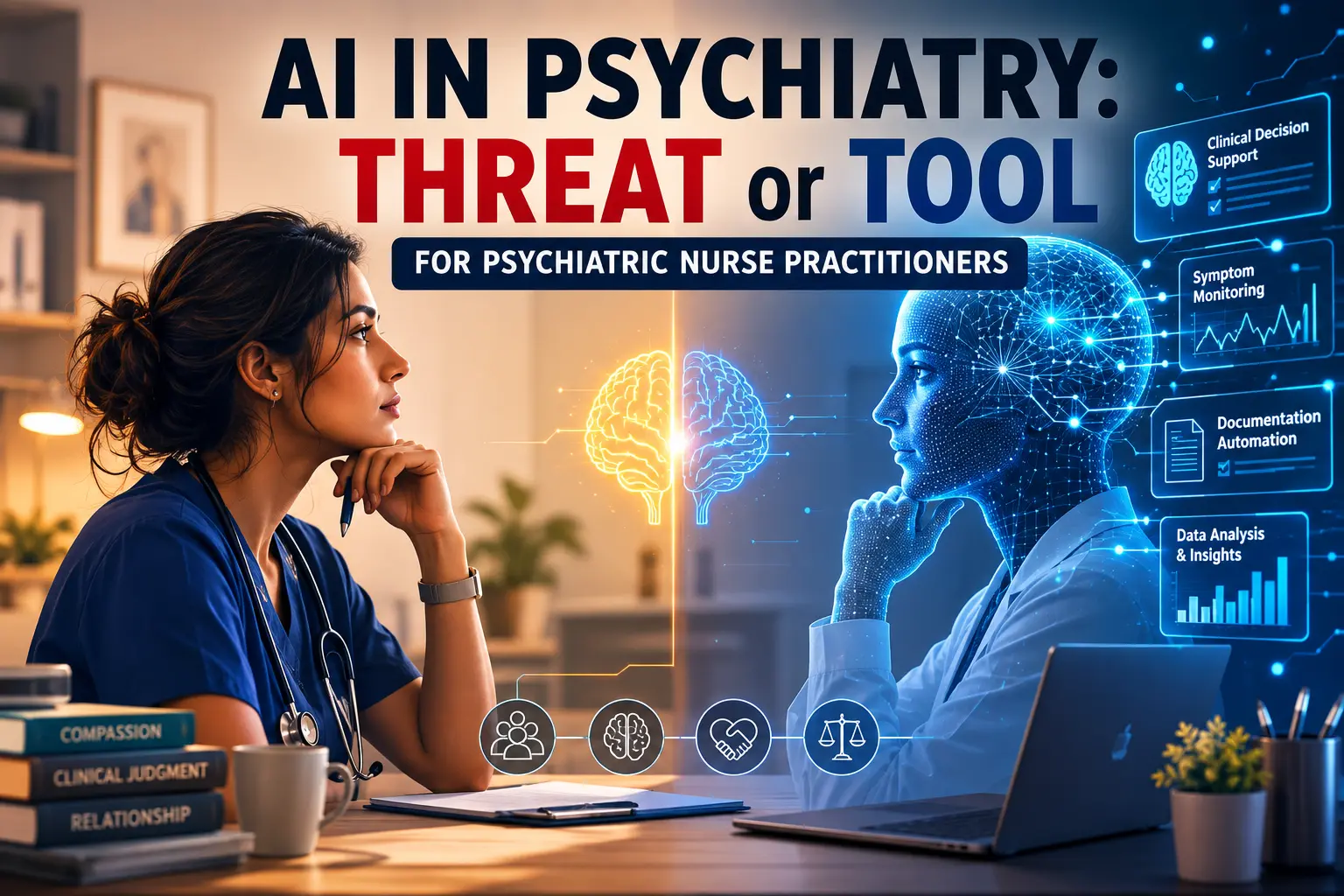
AI in Psychiatry Is Already Changing Clinical Practice
The adoption of AI in psychiatry is real, although it is still concentrated primarily in supporting workflows rather than replacing direct clinical care.
The American Psychiatric Association's 2026 survey of more than 2,000 practicing psychiatrists in the United States and Canada found that 26% reported using AI for clinical note-taking and 16% for administrative tasks. The survey also found that 53% had not used AI in their practice. [2]
Those numbers tell an important story.
AI in psychiatry is not yet a fully automated clinical environment. Instead, it is becoming an additional layer around psychiatric practice.
And the professional community is conflicted.
In the same APA survey, 40% of psychiatrists said AI-assisted treatment was riskier than traditional strategies, while 38% believed AI could make professionals more effective. Another 23% were uncertain about the balance between risks and benefits. [2]
That is not consensus.
It is a debate.
And perhaps that is exactly where the discussion should begin.
AI in Psychiatry: The Case That Psych NPs Could Be Replaced
The strongest argument for AI replacing portions of psychiatric work is not science fiction.
It is economics.
Healthcare systems are under constant pressure to increase access, reduce costs, and manage growing demand with limited clinical resources. The World Health Organization has explicitly recognized AI's potential to address workforce shortages and resource limitations while improving access to health services. [3]
AI has several advantages that human clinicians cannot easily replicate.
It does not need sleep.
It can process enormous quantities of information.
It can operate continuously.
It can deliver standardized interventions at scale.
And it can potentially interact with thousands of patients simultaneously.
The clinical evidence is becoming more interesting as well.
A 2024 systematic review and meta-analysis examined 18 randomized controlled trials involving 3,477 participants and found that AI-based chatbots produced statistically significant improvements in depression and anxiety symptoms. The effects were strongest after approximately eight weeks, although they were not maintained at three-month follow-up. [4]
Then came a 2026 randomized clinical trial published in JAMA Network Open.
The study included 995 university students experiencing psychological distress and compared a conversational AI intervention with face-to-face group therapy and a waiting-list control. The AI group showed greater reductions in anxiety than both comparison groups and greater reductions in depression than the waiting-list group. The researchers concluded that conversational AI could potentially serve as a scalable adjunct to mental healthcare. [5]
That finding deserves attention.
Because it means the argument that AI is incapable of producing meaningful mental-health benefits is becoming increasingly difficult to defend.
But there is a critical distinction.
AI demonstrating clinical benefit does not automatically mean AI can replace the clinician.
It means AI can perform some clinically meaningful functions.
Those are not the same thing.
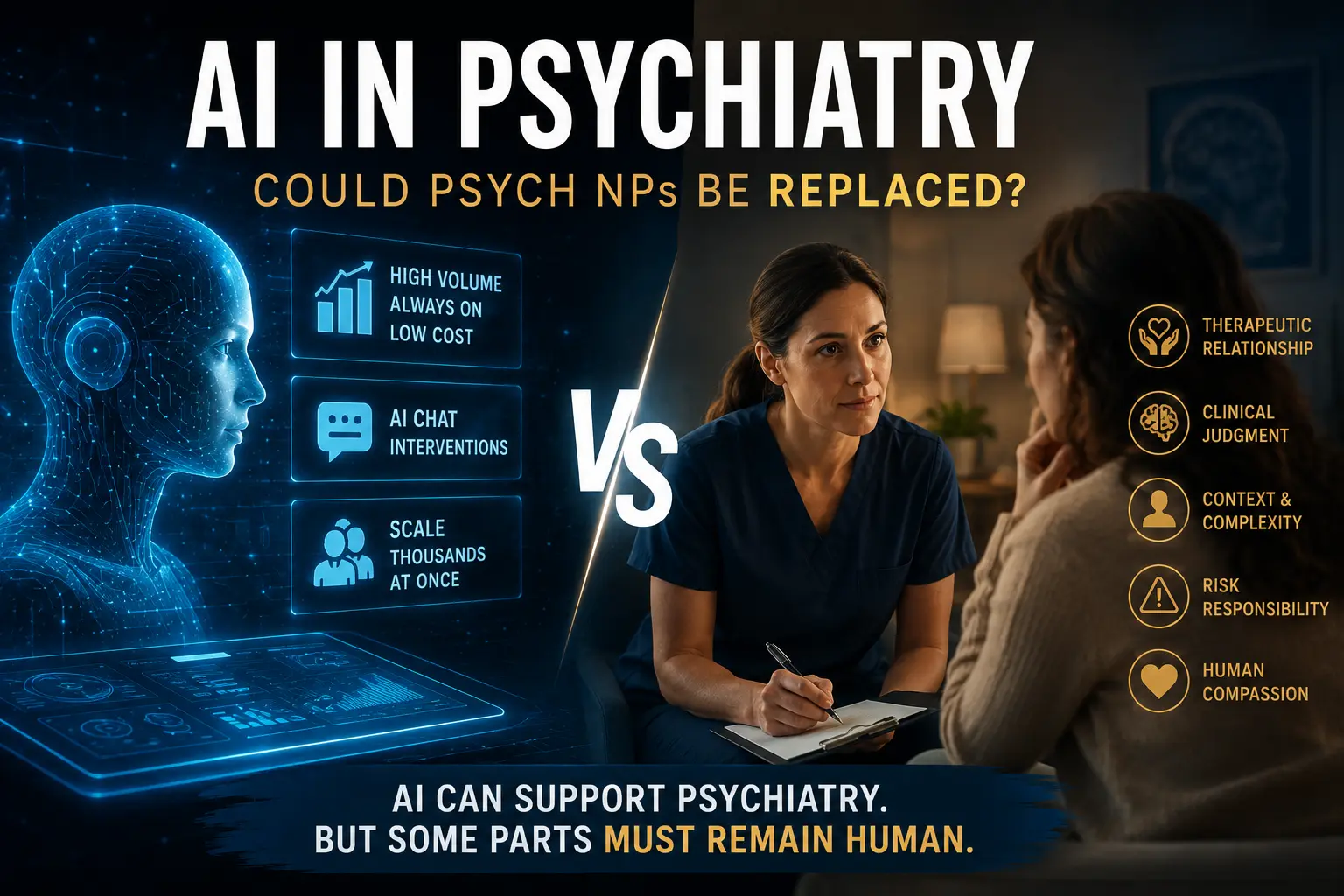
AI in Psychiatry: What the Machine Still Does Not Understand
Psychiatric diagnosis is rarely a simple exercise in recognizing symptoms.
Imagine a patient saying:
"I'm anxious. I can't sleep. My thoughts are racing. I can't sit still."
An AI system might identify anxiety, insomnia, agitation, medication effects, or several psychiatric possibilities.
But the Psych NP asks:
When did this begin?
Did it occur before or after the medication change?
What does "racing thoughts" actually mean?
Does the patient feel afraid, internally restless, energized, or physically compelled to move?
Are they taking the medication consistently?
Is there a history of mood elevation?
Could a medical condition be contributing?
These questions transform the clinical picture.
The problem is not that AI cannot recognize words.
The problem is that the same words can represent very different clinical phenomena.
This is one reason the World Health Organization has emphasized that AI in healthcare requires governance, ethical safeguards, transparency, privacy protections, and human oversight. WHO has specifically warned that generative AI systems can produce inaccurate, biased, or incomplete information and has issued guidance calling for responsible deployment. [3,6]
The distinction is fundamental:
AI can generate information.
The clinician must determine what that information means.
AI in Psychiatry Case Study: When the Pattern Is Right but the Meaning Is Wrong
Consider this illustrative clinical scenario.
A 34-year-old patient returns several days after an antidepressant dose increase.
She says:
"My anxiety is unbearable."
An AI-supported system reviews the encounter and identifies worsening anxiety, insomnia, agitation, and increased distress. It recommends consideration of additional treatment for anxiety.
On the surface, the recommendation seems reasonable.
But the Psych NP asks a more specific question:
"When you say you cannot relax, what does that feel like in your body?"
The patient describes an intense internal urge to move. She cannot sit still. She paces around the house. She feels as though she has to keep moving to escape an unbearable internal sensation.
Then comes the crucial piece of information.
The symptoms began shortly after the medication dose was increased.
The differential diagnosis changes.
The clinician now has reason to consider akathisia, rather than simply assuming that the patient's anxiety has worsened.
This case is deliberately illustrative, not a published patient case. Its purpose is to demonstrate a fundamental problem with AI-assisted psychiatric reasoning.
The AI did not necessarily identify the wrong information.
It identified the information it was given.
The clinical error would occur if the clinician treated the generated interpretation as the conclusion rather than as a prompt for further assessment.
That is the difference between pattern recognition and clinical reasoning.
And it may become one of the defining skills of the AI era.
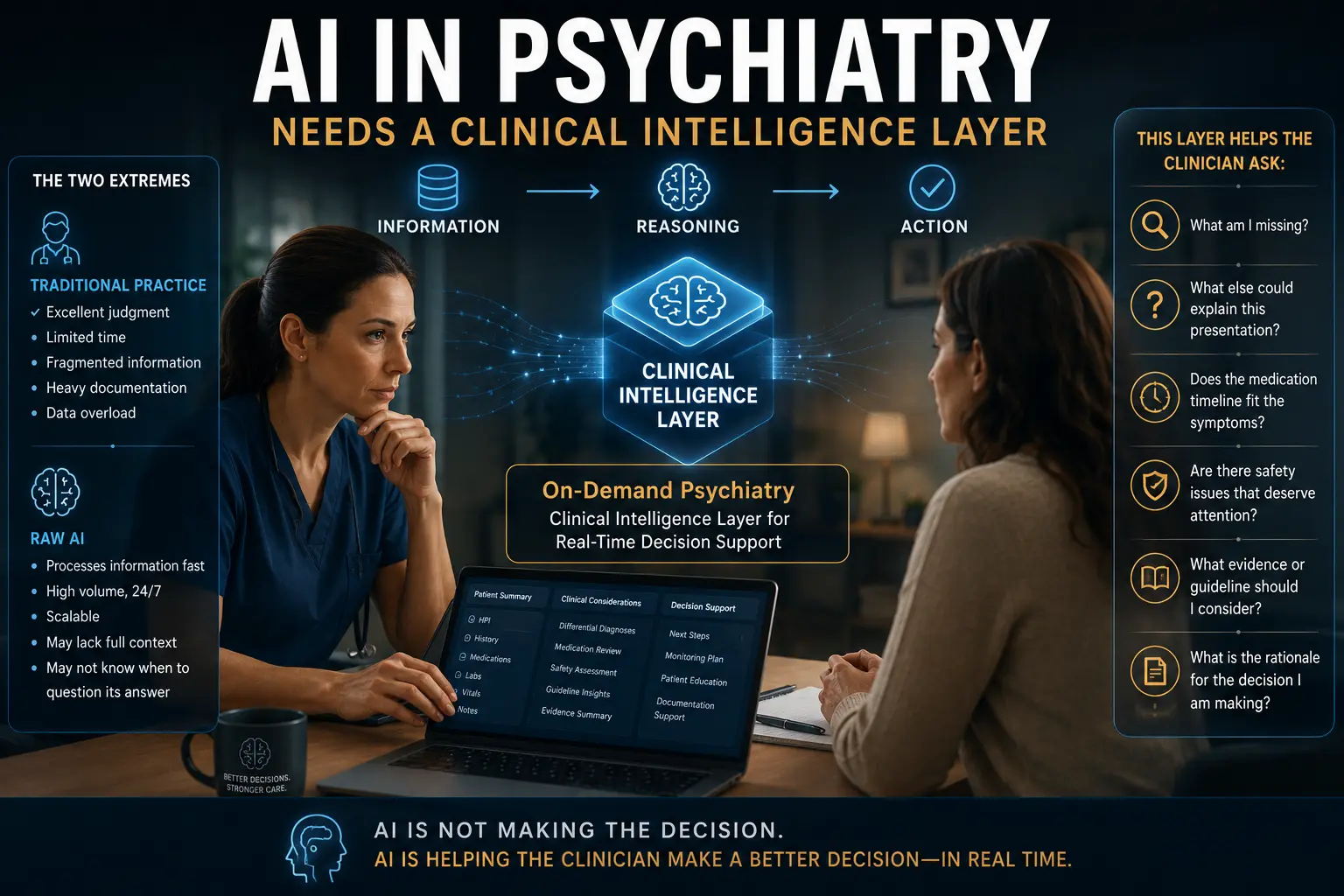
AI in Psychiatry Needs a Clinical Intelligence Layer
This is where the conversation becomes more nuanced.
There is a growing space between two extremes.
On one side is traditional practice, where clinicians may have excellent judgment but limited time, fragmented information, heavy documentation requirements, and an enormous volume of data to process.
On the other side is raw AI, which can process information rapidly but may generate an answer without understanding the full clinical context or knowing when its own answer should be questioned.
Neither extreme is ideal.
What is needed is a layer that helps clinicians move from information to reasoning to action.
This is the problem that On-Demand Psychiatry, Clinical Intelligence Layer for Real-Time Decision Support, is designed to address.
The concept is not to place another autonomous decision-maker between the clinician and patient. Instead, it is to create a clinical intelligence layer that can organize relevant information, surface potential diagnostic or treatment considerations, support real-time reasoning, and help clinicians document the reasoning behind a decision.
That distinction matters.
The value of such a system is not that it tells the Psych NP what to do.
Its value is that it can help the Psych NP ask:
What am I missing?
What else could explain this presentation?
Does the medication timeline fit the symptoms?
Are there safety issues that deserve attention?
What evidence or guideline should I consider?
What is the rationale for the decision I am making?
In a busy psychiatric encounter, those questions can be difficult to work through systematically.
A clinical intelligence layer can help bring them into the workflow rather than forcing clinicians to leave the encounter, search through fragmented resources, and reconstruct their reasoning afterward.
That is a very different vision of AI in psychiatry.
It is not AI making the decision.
It is AI helping the clinician make a better decision in real time.
AI in Psychiatry May Make Some Psych NPs More Valuable
There is a paradox at the center of the AI debate.
The better AI becomes at repetitive work, the more valuable distinctly human clinical capabilities may become.
Consider documentation.
If AI can produce a preliminary clinical note, the Psych NP may spend less time reconstructing the encounter and more time evaluating the patient's actual clinical needs.
If AI can flag a potential medication interaction, the clinician can determine whether that interaction matters in this particular patient.
If AI can identify changes in symptom scores, the clinician can investigate why those changes occurred.
If AI can organize a complex psychiatric history, the clinician can focus on interpreting the history.
A clinical intelligence platform can extend this concept by connecting these functions to the clinical reasoning process itself.
Instead of treating documentation as something that happens after clinical reasoning, documentation can become part of the reasoning workflow.
The clinician considers the differential.
The system helps organize relevant information.
The clinician evaluates potential treatment options.
The reasoning is captured.
The final clinical decision remains the clinician's responsibility.
That is augmentation rather than substitution.
And that distinction matters.
The AMA's 2025 physician survey found that clinicians were already using AI for documentation, charting, care plans, progress notes, translation, and assistive diagnosis. [1]
The most immediate opportunity may therefore be less about asking AI to become the psychiatrist or Psych NP and more about asking:
What work is consuming clinical time without actually requiring clinical judgment?
That is where AI may provide its greatest early value.
AI in Psychiatry Is Not Just a Clinical Opportunity. It Is a Safety Problem.
The greatest danger may not be that clinicians refuse to use AI.
It may be that they trust it too much.
Large language models can produce answers that sound authoritative while being inaccurate. A 2024 systematic review of 40 studies examining large language models in mental health found applications ranging from mental-health screening and suicidal-ideation detection to conversational agents and other clinical applications, while also highlighting substantial challenges surrounding their clinical use. [7]
Psychiatric care makes these limitations particularly consequential.
A wrong recommendation about a restaurant is inconvenient.
A wrong recommendation about a psychiatric medication, suicide risk, diagnosis, or treatment plan can cause harm.
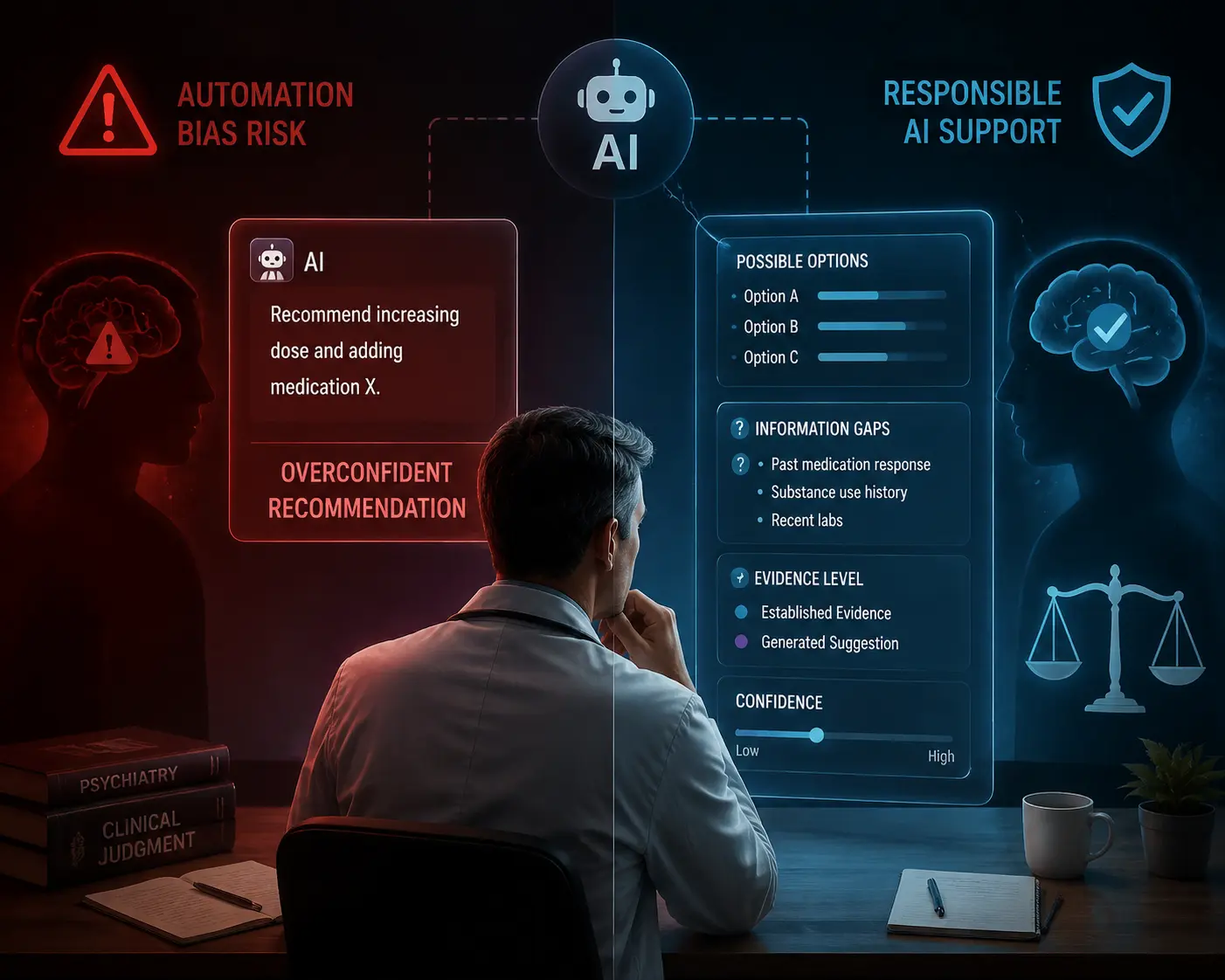
This is where automation bias becomes dangerous.
If a clinician assumes that a computer-generated answer is more objective than their own clinical reasoning, AI can become an amplifier of error rather than a reduction in error.
A clinical intelligence approach should therefore make uncertainty visible rather than hiding it.
The system should help surface alternatives.
It should identify information gaps.
It should distinguish between established evidence and generated suggestions.
And, critically, it should make it easier for the clinician to challenge the recommendation.
The goal is not to create an AI that always sounds certain.
The goal is to create a system that helps the clinician recognize when certainty is not justified.
AI in Psychiatry and the Privacy Question
Psychiatric records contain some of the most sensitive information in healthcare.
Patients disclose trauma, suicidal thoughts, substance use, family conflict, relationship problems, psychotic experiences, sexual concerns, and deeply personal fears.
Using AI in psychiatric care therefore raises questions that cannot be treated as technical footnotes.
Where is the information stored?
Who can access it?
How long is it retained?
Is it being used to train another model?
Does the patient know AI is involved?
The APA's 2026 survey found strong support among psychiatrists for safeguards: 86% supported evidence-based standards for AI mental-health apps, while 83% supported stronger data-privacy protections. [2]
WHO similarly emphasizes privacy, autonomy, equity, accountability, and human rights in AI governance. Its guidance on large multimodal models includes recommendations for independent auditing, impact assessments, regulation, and meaningful involvement of healthcare professionals and patients in AI development. [6]
For any clinical intelligence system, therefore, privacy cannot be an afterthought.
It has to be part of the architecture.
AI in Psychiatry Requires AI-Literate Psych NPs
Psych NPs do not need to become software engineers.
But they increasingly need to become AI-literate clinicians.
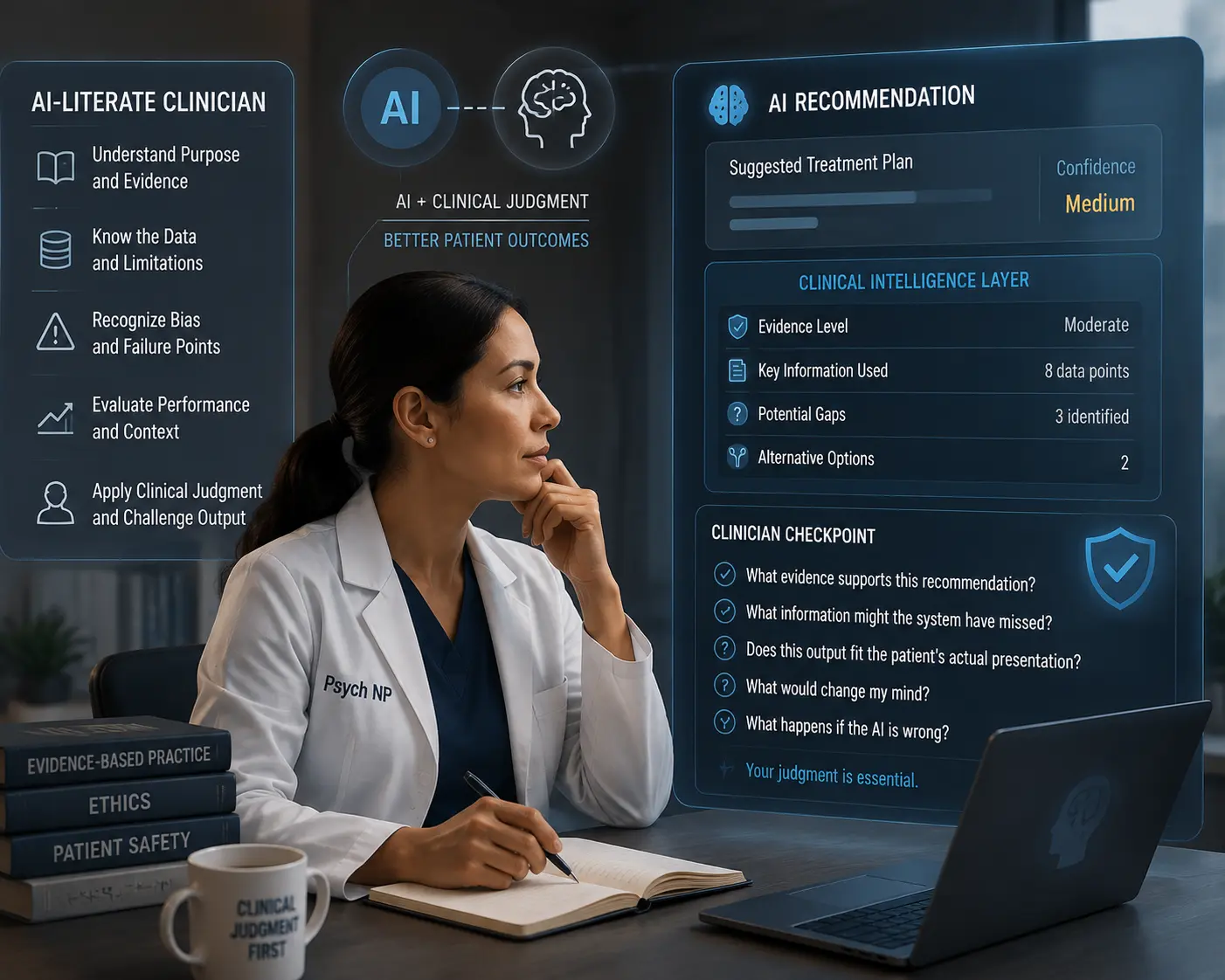
That means understanding what an AI system was designed to do, what evidence supports it, what data it uses, where it can fail, how its performance was evaluated, and when its output should be challenged.
The APA survey reveals a significant gap. Sixty-five percent of psychiatrists described themselves as somewhat informed about AI, but only 18% considered themselves very informed. Most importantly, 80% were very or moderately concerned that mental-health professionals lack adequate AI training. [2]
That may be one of the most important findings in the entire debate.
The greatest competitive advantage for clinicians may not be knowing how to build AI.
It may be knowing when not to trust it.
A clinical intelligence layer can support that skill by making reasoning more explicit.
The future clinician will need to ask:
What evidence supports this recommendation?
What information might the system have missed?
Does this output fit the patient's actual presentation?
What would change my mind?
What happens if the AI is wrong?
Those are clinical questions.
Resolving the AI in Psychiatry Debate
So, is AI in psychiatry a threat or a tool for Psych NPs?
The evidence suggests that it can be both.
It is a threat when organizations use it primarily to eliminate clinical labor, when patients are pushed toward automation because it is cheaper, when clinicians surrender judgment to algorithms, or when systems are deployed without adequate validation and oversight.
But it becomes a tool when it reduces administrative burden, expands access, supports monitoring, assists documentation, identifies patterns, and gives clinicians more time for complex human work.
This is where the idea of a clinical intelligence layer becomes important.
The future should not require clinicians to choose between fragmented traditional workflows and autonomous AI.
There is another possibility:
AI that works alongside clinical reasoning.
A system that helps organize the case.
A system that surfaces possibilities.
A system that identifies gaps.
A system that supports treatment reasoning.
A system that helps document why a decision was made.
But ultimately, a system that leaves the decision with the clinician.
That is the model behind On-Demand Psychiatry, Clinical Intelligence Layer for Real-Time Decision Support.
Its relevance to the broader AI debate is not that it makes AI more powerful.
It is that it places AI's capabilities inside a framework designed around the clinician's reasoning process.
That distinction is essential.
Because the goal of clinical AI should not be to make clinicians unnecessary.
It should make good clinical reasoning easier to perform consistently, especially when clinicians are under pressure.
The Future of AI in Psychiatry Is Not AI Versus Psych NPs
The future is unlikely to be a dramatic moment when a machine walks into a psychiatric clinic and replaces the entire workforce.
The disruption will probably be much quieter.
One clinician will use AI to reduce documentation time.
Another will use it to organize a complicated chart.
Another will use it to monitor symptoms between visits.
Another will use it to support patient education.
Another will use a clinical intelligence system to challenge a premature diagnosis or reconsider a treatment decision.
And another will refuse to use AI altogether.
Over time, the important distinction may not be between clinicians who use AI and clinicians who do not.
It may be between clinicians who understand AI and clinicians who simply trust AI.
Some tasks performed by Psych NPs will almost certainly change.
Some may disappear.
New responsibilities will emerge.
But automating a task is not the same thing as automating psychiatric care.
Psychiatry is not valuable because clinicians can produce information faster than machines.
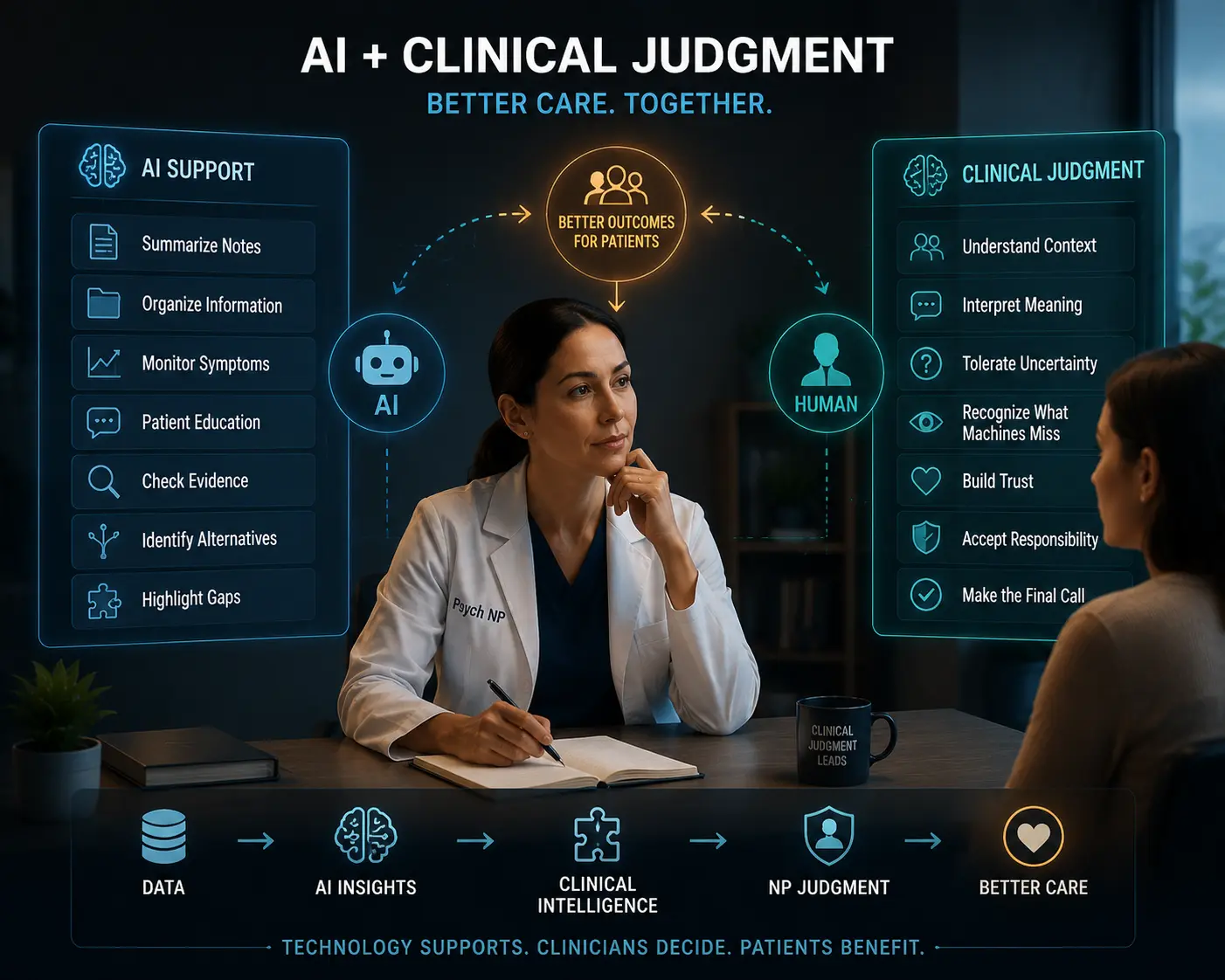
It is valuable because clinicians can determine what information matters, interpret it in context, tolerate uncertainty, recognize when the obvious explanation is wrong, build trust, and accept responsibility for the decision that follows.
AI can help produce an answer.
Clinical intelligence can help structure the reasoning around that answer.
The Psych NP still has to decide whether it is the right answer.
That is why the future of AI in psychiatry should not be framed as a choice between technology and humanity.
The real opportunity is more demanding.
We need a psychiatric workforce that is technologically capable enough to use AI, clinically sophisticated enough to challenge it, and human enough to recognize when a patient needs something a machine cannot provide.
The future is not AI versus Psych NPs.
It is Psych NPs using AI without surrendering their clinical judgment to it.
And the most valuable psychiatric technology may ultimately be the technology that does not try to think instead of the clinician, but helps the clinician think more clearly when the stakes are highest.
Frequently Asked Questions About AI in Psychiatry and Psych NPs
Can AI replace Psychiatric Nurse Practitioners?
AI can automate specific tasks performed by Psych NPs, but that is different from replacing the entire clinical role. Psychiatric assessment involves diagnosis, risk evaluation, treatment decisions, longitudinal context, therapeutic relationships, and professional accountability.
How are Psych NPs using AI?
AI can support documentation, administrative work, chart summarization, patient education, symptom monitoring, clinical decision support, and other workflow tasks. Current APA data suggests that psychiatric AI use is still concentrated primarily in note-taking and administrative work. [2]
What is a clinical intelligence layer?
A clinical intelligence layer is an AI-enabled system designed to support the clinician's reasoning process by organizing information, identifying potential gaps or considerations, supporting decision-making, and helping document clinical reasoning. It is different from an autonomous system that independently makes clinical decisions.
Is AI safe in mental healthcare?
AI can be useful, but safety depends on the specific system, its validation, intended use, privacy protections, and clinical oversight. AI-generated information should not automatically be treated as accurate simply because it sounds convincing.
Can AI diagnose psychiatric disorders?
AI can assist with pattern recognition and clinical decision support, but psychiatric diagnosis should not be reduced to an automated output. Clinical diagnosis requires context, differential diagnosis, longitudinal information, and professional judgment.
What is the biggest risk of AI in psychiatry?
One major risk is overreliance. If clinicians accept AI recommendations without critically evaluating them, automation can amplify clinical errors instead of preventing them.
Do Psych NPs need AI training?
Increasingly, yes. Psych NPs do not necessarily need to become AI developers, but they need sufficient AI literacy to understand how these systems work, where they fail, how bias can occur, and when an AI recommendation requires additional scrutiny. The APA found that 80% of surveyed psychiatrists were concerned that mental-health professionals do not have adequate AI training. [2]
Can AI actually improve mental-health outcomes?
There is emerging evidence that it can. A 2024 meta-analysis of 18 randomized controlled trials involving 3,477 participants found modest improvements in depression and anxiety symptoms with AI-based chatbot interventions, although those effects were not sustained at three-month follow-up. [4]. A 2026 randomized clinical trial involving 995 university students also found improvements in anxiety, depression, and well-being with a conversational AI intervention. [5]
What is the most realistic future for AI in psychiatry?
The most realistic model is probably hybrid care. AI will increasingly handle selected administrative, analytical, monitoring, and engagement functions while clinicians retain responsibility for assessment, interpretation, treatment decisions, therapeutic relationships, and patient safety.
- American Medical Association. 2 in 3 physicians are using health AI, up 78% from 2023. 2025. Link
- American Psychiatric Association. Survey of APA Members Reveals Optimism, Concern About Use of AI in Practice. 2026. Link
- World Health Organization. Artificial Intelligence for Health. 2024. Link
- Zhong W, Luo J, Zhang H. The therapeutic effectiveness of artificial intelligence-based chatbots in alleviation of depressive and anxiety symptoms in short-course treatments: a systematic review and meta-analysis. Journal of Affective Disorders. 2024;356:459-469. doi:10.1016/j.jad.2024.04.057. Link
- Shoshani A, Gurfinkel B, Kor A, et al. Efficacy of a Conversational AI Agent for Psychiatric Symptoms and Digital Therapeutic Alliance: A Randomized Clinical Trial. JAMA Network Open. 2026;9(4):e266713. doi:10.1001/jamanetworkopen.2026.6713. Link
- World Health Organization. Ethics and Governance of Artificial Intelligence for Health: Guidance on Large Multi-Modal Models. 2025. Link
- Guo Z, Lai A, Thygesen JH, Farrington J, Keen T, Li K. Large Language Models for Mental Health Applications: Systematic Review. JMIR Mental Health. 2024;11:e57400. doi:10.2196/57400. Link
This article is intended for licensed healthcare professionals. It does not provide medical advice, diagnose conditions, or substitute for clinical judgment. All clinical decisions must be made by a qualified clinician familiar with the individual patient. For emergencies, call 911. For mental health crisis support in the US, call or text 988.