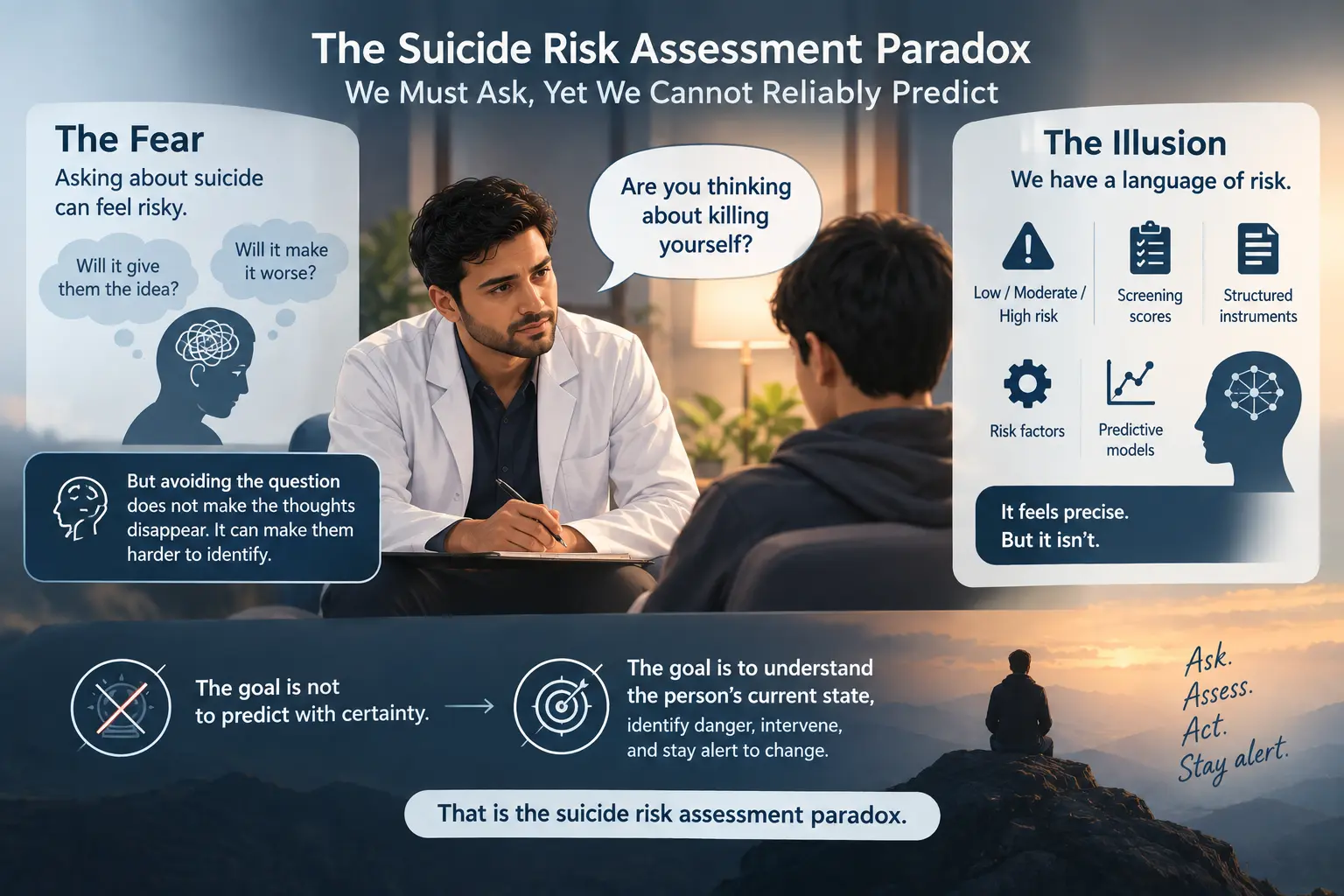
There is an uncomfortable contradiction at the center of suicide risk assessment: clinicians must ask about suicide, yet no clinician can reliably predict who will die by suicide. This is what makes suicide prevention one of the most difficult challenges in psychiatry. A clinician may hesitate to ask, “Are you thinking about killing yourself?” because of the persistent fear that talking about suicide could introduce the idea or make suicidal thinking worse. But avoiding the question does not make suicidal thoughts disappear. It can make them harder to identify.
At the same time, psychiatry has developed an extensive language of risk: low risk, moderate risk, high risk, screening scores, structured instruments, risk factors, and predictive models. These can create the impression that suicide can be reduced to a sufficiently precise clinical calculation.
It cannot.
That does not mean suicide assessment is futile. It means its purpose needs to be understood correctly.
The goal is not to discover a magic question, score, or algorithm that can tell us with certainty who will attempt suicide. The goal is to understand the person's current clinical state well enough to identify danger, intervene appropriately, and remain alert to what could change.That distinction is at the heart of the suicide risk assessment paradox.
The First Controversy: Does Asking About Suicide Put the Idea in Someone's Head?
For years, one of the most persistent misconceptions surrounding suicide assessment has been that asking directly about suicidal thoughts might plant the idea in someone's mind.
The evidence and clinical guidance do not support avoiding the question.
NICE recommends that clinicians directly ask people with depression about suicidal ideation and intent, particularly when there are concerns about self-harm or suicide (NICE, 2022). Direct questioning is not about encouraging suicidal thinking. It is about creating an opportunity for disclosure.
A person experiencing suicidal thoughts may already be carrying them privately. The clinician's question does not necessarily introduce something new. It may simply communicate that the subject is safe enough to discuss.
The question matters, but so does what follows
Asking “Are you suicidal?” and accepting a one-word answer is not a meaningful assessment.
A clinically useful conversation moves beyond the initial response.
If the patient says no, the clinician still needs to understand what prompted the question. If the patient says yes, the next step is not automatically hospitalization.
The assessment should explore the person's thoughts, intent, planning, access to potentially lethal means, previous suicidal behavior, recent changes, psychiatric symptoms, substance use, social circumstances, protective factors, and ability to engage with a safety plan.
The purpose is not simply to obtain an answer.
It is to understand the person behind the answer.
The Second Controversy: Can Suicide Risk Actually Be Predicted?
This is where the debate becomes more uncomfortable.
Clinical instruments can organize information, but their predictive accuracy has important limitations. A systematic review of suicide risk assessment instruments found that, among the instruments that could be adequately evaluated, none met predefined requirements for sufficient diagnostic accuracy (Carter et al., 2017).
A separate meta-analysis examining clinical risk scales found that the pooled positive predictive value for suicide was only 5.5%, although predictive performance varied depending on the outcome being measured and the instrument used (Carter et al., 2017).
These findings do not mean that every structured approach is useless.
They mean something more important: prediction is not the same thing as clinical understanding.
Why prediction is different from formulation
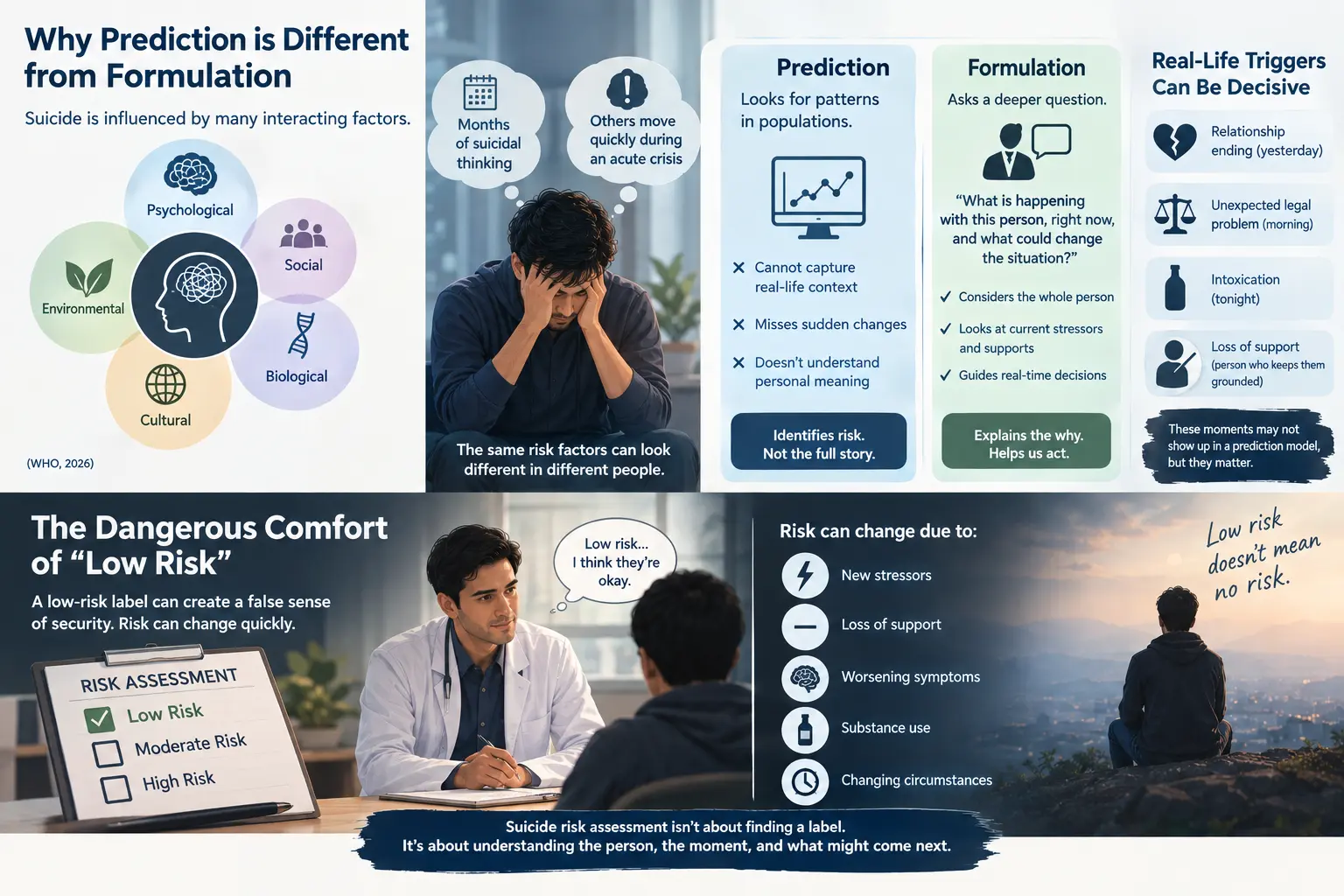
Suicide is influenced by multiple interacting factors. The World Health Organization describes suicide as a multifaceted phenomenon involving psychological, social, biological, cultural, and environmental factors (WHO, 2026).
Some people experience suicidal thinking for months. Others move rapidly from distress to suicidal behavior during an acute crisis.
A prediction model may identify patterns across populations. It cannot fully capture the meaning of a relationship ending yesterday, an unexpected legal problem this morning, intoxication tonight, or a patient suddenly losing access to the person who normally keeps them grounded.
Clinical formulation asks a different question:
What is happening with this person, right now, and what could change the situation?
The Dangerous Comfort of “Low Risk”
Imagine a 29-year-old patient presenting with worsening depression after the end of a significant relationship.
When asked directly about suicide, the patient says no.
There is no stated plan. No reported previous attempt. No obvious access issue. They remain employed and attend the appointment voluntarily.
It would be easy to conclude that the patient is “low risk.”
But further conversation reveals that they have stopped seeing friends, increased alcohol consumption, stopped exercising, are sleeping poorly, and recently gave away several personal possessions.
Eventually, the patient says:
“I don't want to die. I just don't want to keep living like this.”
The clinical picture has changed.
When a “no” becomes clinically incomplete
The patient technically denied suicidal ideation at the beginning of the assessment. But the broader formulation suggests significant distress, social withdrawal, worsening functioning, substance use, and possible passive death wishes.
This is precisely why NICE advises against using global categories such as “low,” “medium,” or “high” risk to predict suicide or determine treatment or discharge (NICE, 2022).
The problem with a static label is that it can create false reassurance.
Risk is not a permanent characteristic of a person.
It can change.
A Clinical Case: When “Denies SI” Is Not the End of the Assessment
Consider a 42-year-old woman with recurrent major depressive disorder who presents with worsening mood, insomnia, hopelessness, and increasing withdrawal from family.
During the initial interview, she denies suicidal ideation.
If the assessment ends there, the documentation may simply state:
“Denies SI/HI.”
But the clinician continues exploring.
She acknowledges that she has recently begun thinking that her family would be “better off without me.” She denies intent and has no current plan or preparatory behavior. She has been drinking more alcohol, has stopped attending activities she previously enjoyed, and has become increasingly isolated.
At the same time, she identifies her children as a strong reason for living and is willing to involve her spouse in the safety plan.
What changed the formulation?
Nothing magical happened.
The clinician simply asked enough questions to move from a binary answer to a clinical formulation.
The patient did not suddenly become “high risk.” Instead, the clinician gained a more accurate understanding of her current vulnerabilities, protective factors, trajectory, and immediate needs.
That distinction matters because the appropriate response is not automatically hospitalization.
Depending on the overall clinical picture, intervention may involve strengthening social support, addressing substance use, increasing treatment intensity, developing a collaborative safety plan, reducing access to lethal means where appropriate, and arranging timely follow-up.
If there is considerable immediate danger, urgent specialist intervention is appropriate. NICE specifically recommends urgent referral when a person with depression presents considerable immediate risk to themselves or others (NICE, 2022).
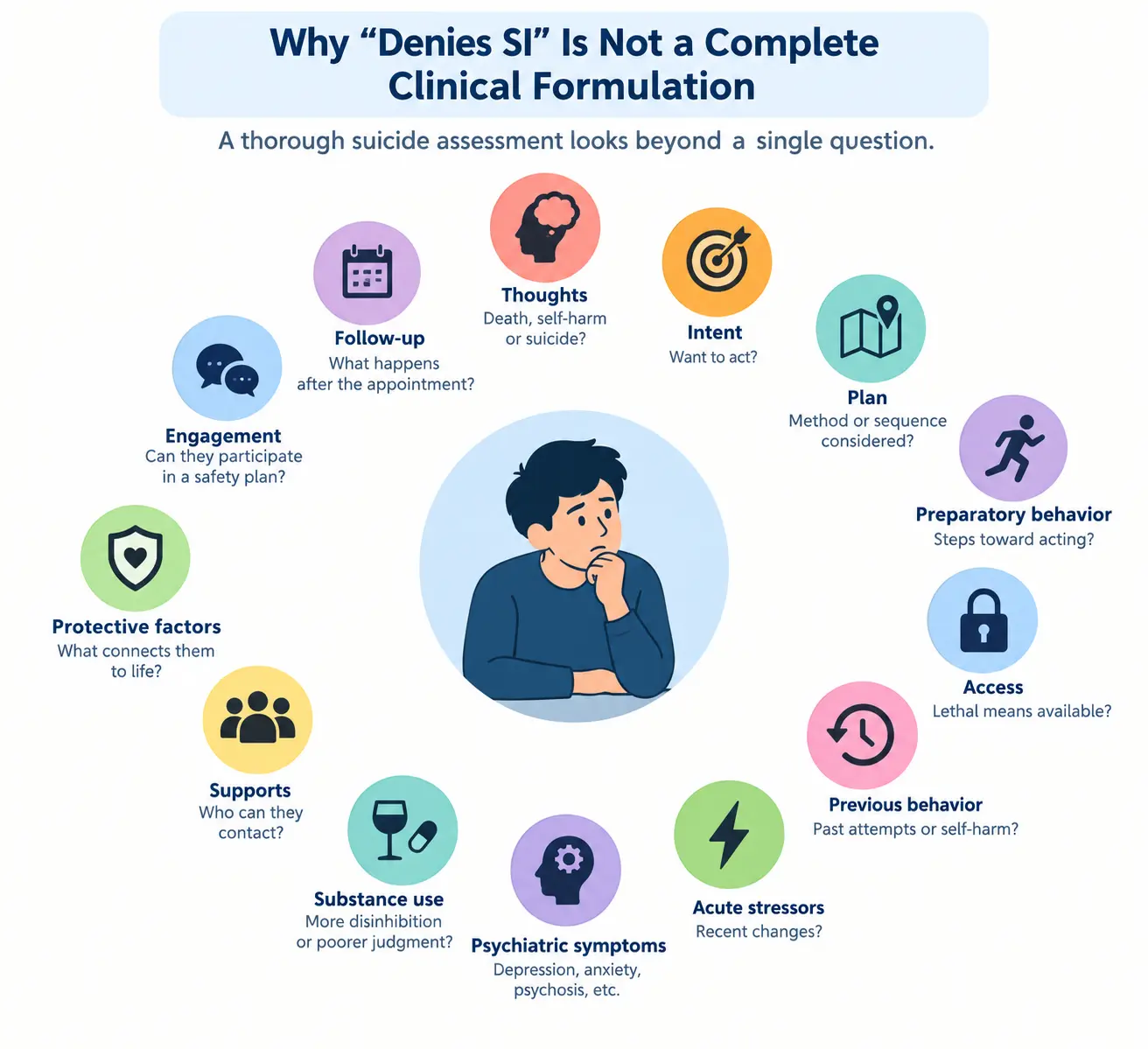
Why “Denies SI” Is Not a Complete Clinical Formulation
A suicide assessment should not be reduced to a single question.
A more comprehensive assessment considers:
Thoughts: Are there thoughts of death, self-harm, or suicide?
Intent: Does the person want to act on those thoughts?
Plan: Has a specific method or sequence been considered?
Preparatory behavior: Has the person taken steps toward acting?
Access: Are potentially lethal means readily available?
Previous behavior: Is there a history of suicide attempts or self-harm?
Acute stressors: Has something recently changed?
Psychiatric symptoms: What is happening with depression, agitation, psychosis, anxiety, hopelessness, or impulsivity?
Substance use: Is alcohol or another substance increasing disinhibition or reducing judgment?
Supports: Who can the person contact?
Protective factors: What currently connects the person to life?
Engagement: Can the person participate meaningfully in a safety plan?
Follow-up: What happens after the appointment?
Risk is dynamic
The World Health Organization notes that suicide can occur in the context of acute crises and that risk factors include loss, loneliness, relationship conflict, financial difficulties, violence, chronic illness, and other forms of severe stress (WHO, 2026).
That means the assessment should capture both current state and trajectory.
A patient who was safe two weeks ago may not be safe today.
A patient who appears distressed today may become substantially safer after receiving support, reducing access to lethal means, treating an acute psychiatric episode, or reconnecting with protective relationships.
The formulation therefore needs to be revisited when circumstances change.
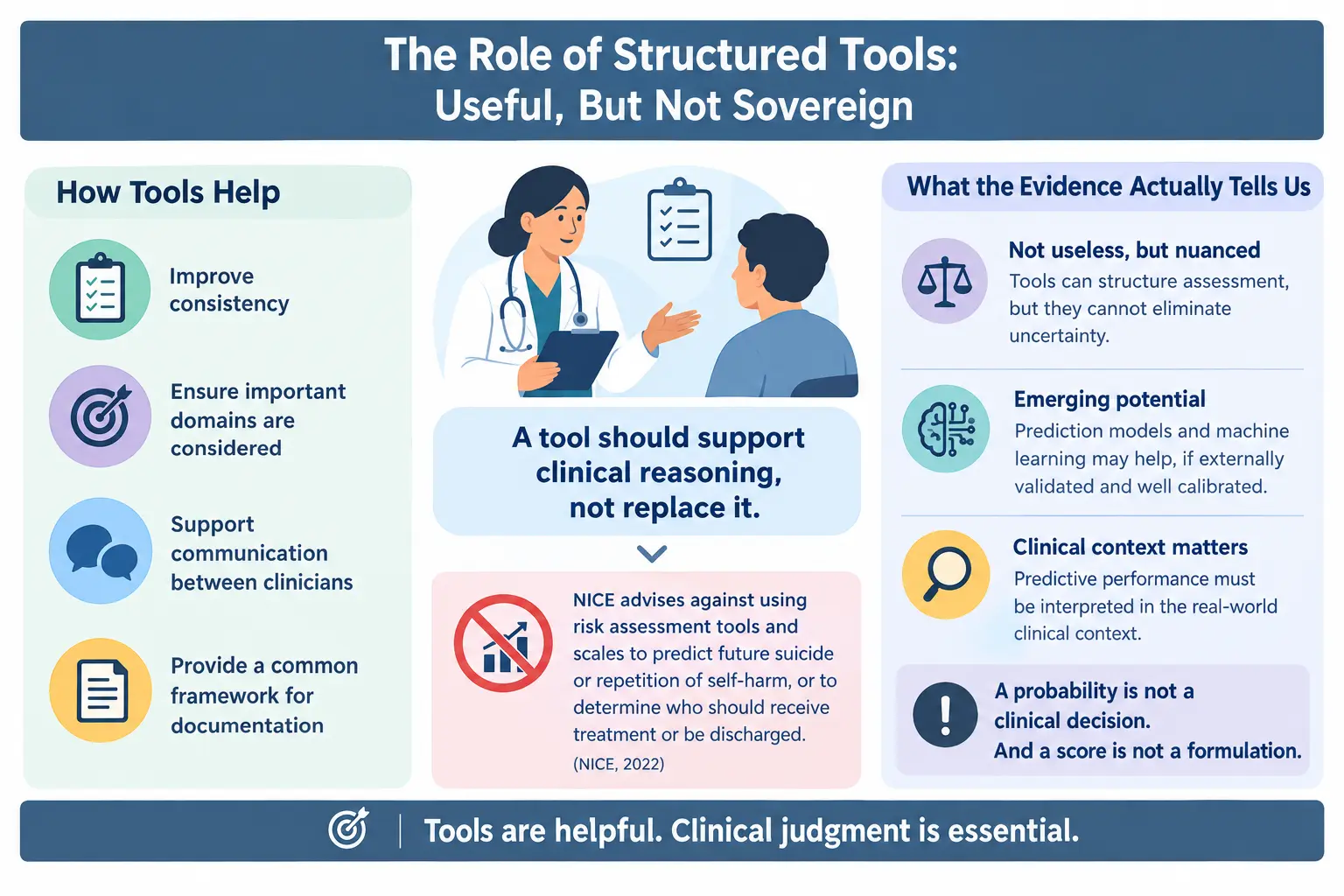
The Role of Structured Tools: Useful, But Not Sovereign
Structured tools have a place in clinical practice.
They can improve consistency, ensure important domains are considered, support communication between clinicians, and provide a common framework for documenting assessment.
But a tool should support clinical reasoning rather than replace it.
NICE explicitly recommends against using risk assessment tools and scales to predict future suicide or repetition of self-harm, or to determine who should receive treatment or be discharged (NICE, 2022).
What the evidence actually tells us
The strongest position is not “tools are useless.”
It is more nuanced:
Tools can structure assessment. They cannot eliminate uncertainty.
That distinction is increasingly important as psychiatry encounters newer prediction models and machine learning approaches. Emerging research suggests that some models may have potential, particularly when externally validated and appropriately calibrated. But predictive performance must still be interpreted in clinical context.
A probability is not a clinical decision.
And a score is not a formulation.
The Real Clinical Question Is Not “High Risk or Low Risk?”
The more useful question is:
What does this patient need to remain safe, and what could make their situation more dangerous?
This aligns closely with the direction of modern clinical guidance. NICE recommends focusing assessment on the person's needs and immediate and longer-term safety, while incorporating risk formulation into psychosocial assessment (NICE, 2022).
That changes the clinician's role.
Instead of asking only:
“Is this patient high risk?”
the clinician begins asking:
“What has changed?”
“What is maintaining the crisis?”
“What protective factors are still active?”
“What could change over the next 24 hours?”
“What information am I missing?”
“What intervention could reduce immediate danger?”
“How will I know if the situation is deteriorating?”
These questions produce a clinical picture rather than a label.
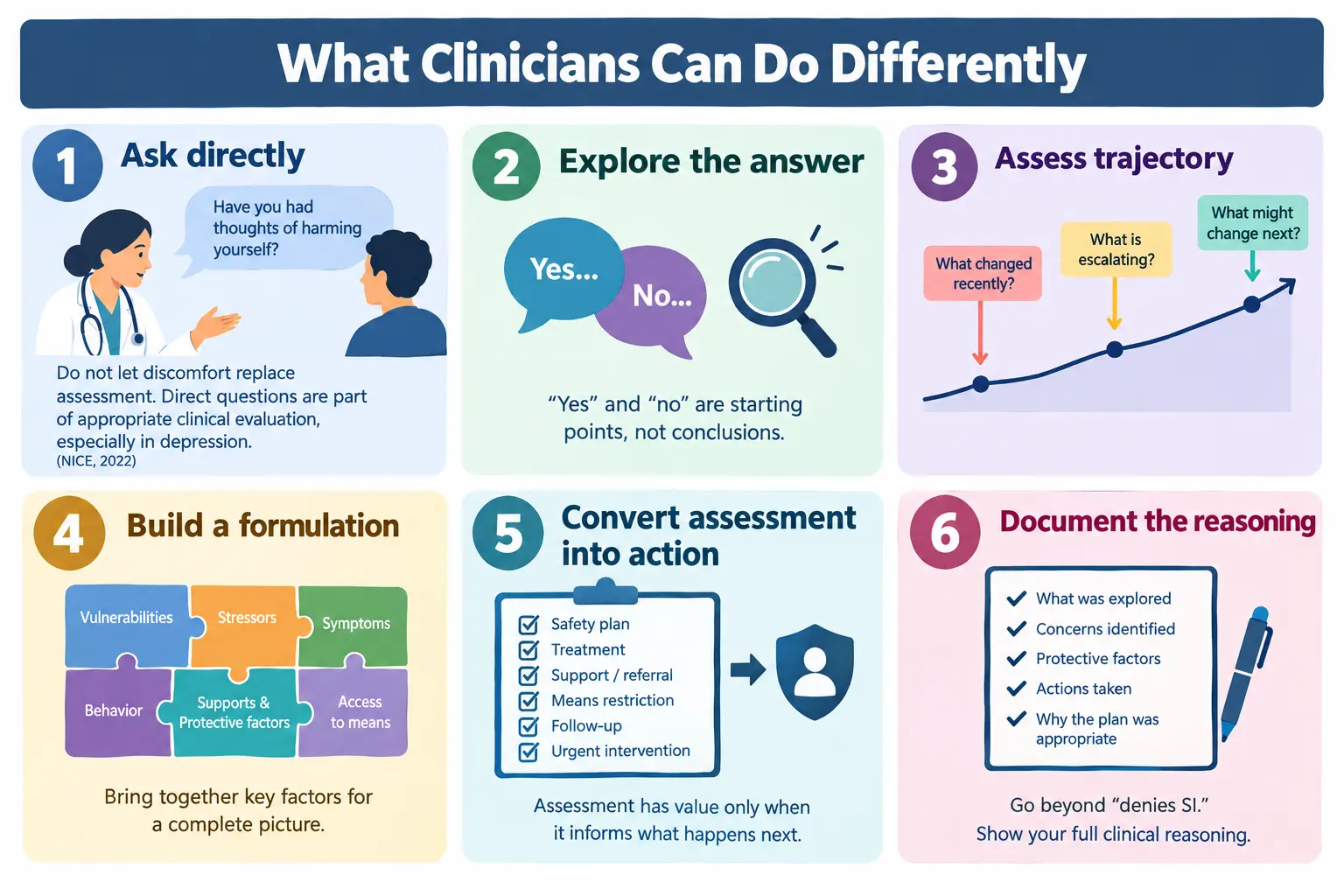
What Clinicians Can Do Differently
1. Ask directly
Do not allow discomfort to replace assessment. Direct questions about suicidal ideation and intent are part of appropriate clinical evaluation, particularly in depression (NICE, 2022).
2. Explore the answer
“Yes” and “no” are starting points, not conclusions.
3. Assess trajectory
Look for what has changed recently, what is escalating, and what may change next.
4. Build a formulation
Bring together vulnerabilities, acute stressors, symptoms, behavior, supports, protective factors, and access to means.
5. Convert assessment into action
Assessment has value only when it informs what happens next: safety planning, treatment, support, referral, means restriction, follow-up, or urgent intervention when necessary.
6. Document the reasoning
Good documentation should communicate more than “denies SI.” It should show what was explored, what concerns were identified, what protective factors were present, what actions were taken, and why the clinical plan was appropriate.
Where Clinical Intelligence Can Help
This is also where technology can have a meaningful supporting role.
On-Demand Psychiatry is designed as a Clinical Intelligence Layer for Real-Time Decision Support, helping clinicians organize complex psychiatric information and surface relevant clinical considerations while keeping the clinician responsible for interpretation and decision-making.
In suicide assessment, that distinction is particularly important.
A clinical intelligence system should not simply generate a “low risk” or “high risk” label. It should not determine disposition or substitute an automated score for clinical judgment.
Its value is in helping clinicians organize information, identify areas that may require further exploration, structure clinical reasoning, and translate that reasoning into clear documentation.
The technology should make thoughtful assessment easier.
It should not pretend that uncertainty has disappeared.
The Resolution: Ask Better, Think Deeper, Reassess
More than 720,000 people die by suicide every year, according to the World Health Organization. Suicide remains a major global public health problem, and many more people attempt suicide than die from it (WHO, 2026).
The answer to the uncertainty surrounding suicide cannot be silence.
Nor can it be blind faith in a score.
We need both courage and humility in clinical practice.
Ask directly. Listen carefully. Formulate dynamically. Intervene proportionately. Document the reasoning. Reassess when the situation changes.
The goal of suicide risk assessment is not perfect prediction.
It is understanding the present well enough to recognize danger, reduce modifiable risk, strengthen protective factors, and respond before a crisis becomes irreversible.
The most dangerous mistake may not be asking the wrong question.
It may be believing that one answer can tell us what happens next.
Frequently Asked Questions
Does asking someone about suicide increase suicidal thoughts?
There is no basis for avoiding direct questions about suicide out of fear that the question itself will cause suicidal thinking. NICE recommends directly asking people with depression about suicidal ideation and intent when clinically indicated (NICE, 2022). The quality of the conversation matters: the question should be asked calmly, directly, and followed by appropriate exploration.
Should every patient who reports suicidal thoughts be hospitalized?
No. Suicidal thoughts do not automatically mean that hospitalization is required. Clinical decisions should consider the overall formulation, including intent, planning, preparatory behavior, access to means, acute symptoms, substance use, protective factors, support, engagement, and immediacy of danger. Where there is considerable immediate risk, urgent specialist assessment is warranted (NICE, 2022).
Can suicide risk assessment tools accurately predict suicide?
Current evidence does not support treating risk scales as reliable predictors of future suicide. NICE specifically advises against using risk assessment tools and global risk categories to predict suicide or determine treatment and discharge decisions (NICE, 2022).
Are structured suicide assessment tools still useful?
They can be useful for structuring conversations, improving consistency, and ensuring important domains are considered. Their limitations arise when they are treated as definitive predictions rather than components of a broader clinical assessment.
What if a patient denies suicidal ideation?
A denial of suicidal ideation should be considered alongside the rest of the clinical picture. Explore recent changes, hopelessness, withdrawal, substance use, previous suicidal behavior, acute stressors, protective factors, and other indicators of deterioration. “Denies SI” should not automatically become the entire risk formulation.
What is the difference between suicide risk assessment and suicide risk formulation?
Assessment involves gathering relevant information. Formulation involves interpreting that information in context: identifying vulnerabilities, current stressors, protective factors, changes over time, and factors that could increase or decrease danger. NICE recommends risk formulation as part of psychosocial assessment by mental health professionals (NICE, 2022).
What is one of the biggest mistakes clinicians can make?
Treating suicide risk as static. A patient's circumstances, symptoms, substance use, relationships, access to means, and willingness to seek help can change rapidly. A meaningful assessment therefore needs to account for trajectory, not simply the patient's status at one moment.
Can AI replace clinical judgment in suicide assessment?
No. AI may help organize information, surface considerations, and support documentation, but it should not independently determine suicide risk, diagnosis, treatment, or disposition. Suicide assessment requires clinical judgment, contextual understanding, therapeutic engagement, and ongoing reassessment.
What should clinicians ultimately ask themselves?
Not simply, “Is this patient high risk?”
A more useful question is:
“What do I need to understand about this person right now to help keep them safe, and what could change that assessment?”
That is the difference between checking a box and practicing clinical psychiatry.
- Carter, G., Milner, A., McGill, K., Pirkis, J., Kapur, N., & Spittal, M. J. (2017). Predicting suicidal behaviours using clinical instruments: Systematic review and meta-analysis of positive predictive values for risk scales. The British Journal of Psychiatry, 210(6), 387–395. DOI
- Carter, G., Milner, A., McGill, K., Pirkis, J., Kapur, N., & Spittal, M. J. (2017). Instruments for the assessment of suicide risk: A systematic review evaluating the certainty of the evidence. PLOS ONE, 12(7), e0180292. DOI
- National Institute for Health and Care Excellence. (2022). Depression in adults: Treatment and management (NG222). NICE. Link
- National Institute for Health and Care Excellence. (2022). Self-harm: Assessment, management and preventing recurrence (NG225). NICE. Link
- World Health Organization. (2026). Suicide. WHO. Link
- World Health Organization. (2026). Suicide: Questions and answers. WHO. Link
This article is intended for licensed healthcare professionals. It does not provide medical advice, diagnose conditions, or substitute for clinical judgment. All clinical decisions must be made by a qualified clinician familiar with the individual patient. For emergencies, call 911. For mental health crisis support in the US, call or text 988.


